
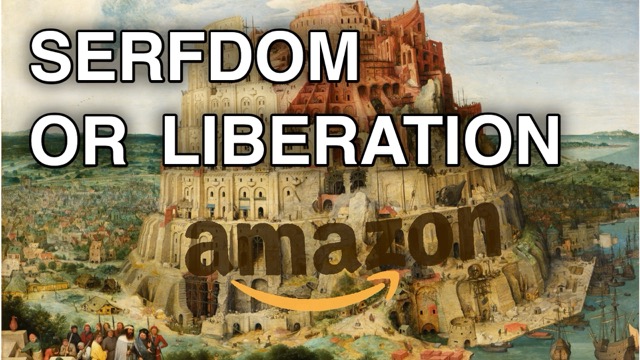
You ever feel like what you do doesn’t matter? That every day you work at a job that doesn’t do anything good for the world and only exists to make money for shareholders, the vast majority of whom are already rich? You ever feel like the work that you dedicate much of your life to has no meaning?
Well, if you do, you’re not alone.
But what if things could be different? What if we could create the conditions in which we can change what labor means and how its done. And what if the material conditions of the world now that seem so despairing can actually help that happen, by way of work becoming more like it was in the Medieval world.
Let me explain.
You see, back in the European medieval era, things were different. Legally all land belonged to the king and therefore the government (which the king embodied). Private property as we think of it now essentially didn’t exist. The king parceled out the kingdom to aristocrats as fiefs, and the aristocrats (also known as lords) had the right to extract money from the people living in their fiefs as rents. (In practice, of course, the relationship between the lords and kings was more complicated than this especially since the lords usually fielded their own armies, but legally everything belonged to the king.)
Most land was cultivated using what was called the “open field” system. The land (or manor) of the lord was farmed by peasants or serfs, who were peasants bound to the land, who received strips of ground to farm that were intentionally distributed in different parts of the manor to make sure no one peasant had all the best farmland. And large parts of the manor were given over to commons where all could graze their animals and gather wood and such. The peasants meanwhile typically lived in nucleated villages separate from the farmland, with multiple families often sharing single cottages. At home, women often took on roles of making things, like the alewives who brewed alcohol. The lord would take a percentage of what the peasants grew as rents and the rest were for them to keep.
Meanwhile, in the cities and towns, peasant artisans took up skilled tasks like metalsmithing, textiles, glasswork, and so on, and peasant merchants who would buy and sell goods for trade. Generally, these artisans were organized into guilds which on the one hand limited who could practice a trade but on the other hand helped ensure things like apprenticeships and work for its members and served to protect their interests. Things were wildly unequal, social mobility was almost unheard of, the concept of civil rights were unknown, and the lot of peasants (and particularly serfs) could be hard. However, you knew your work had meaning because you were growing or making things for yourself, your family, and your community.
With the transition to capitalism, all this changed. Lords discovered for example that they could extract more value from their manor by closing it off to the peasants and just hiring back a small number of them to do one specific, high-value job, like raising sheep for wool. This “enclosure” of the common lands of the manor displaced peasants from their former livelihoods. Poverty in the way we think of it now came to exist for the first time as people starved without the means to support themselves, and masses of peasants left the lands their ancestors had farmed for centuries to move to towns and cities and get jobs in the newly forming factories. Thus instead of growing and making the things they consumed themselves, workers came to depend on the new system of wage labor, where business owners paid them a rate for their time, with that rate governed by a labor market. Meanwhile, particularly with the Age of Discovery and the creation of the first corporations, like the Dutch East India Company founded in 1602, the peasant merchants began amassing wealth on a scale that could rival aristocrats for the first time. Created with these companies were the joint stock corporation, where multiple people could invest money for shares of ownership on a company on the expectation of future dividends, primarily at first as a way for aristocrats to get a piece of the capitalist pie by investing in ventures. (These same aristocrats gave these first joint stock corporations official monopoly status so no one else could come in and take a piece of that pie, at least from the same country.)
These innovations and the cycle of reinvesting earnings to increase productivity that characterizes capitalismhelped drive the industrial revolution and paved the way for amazing innovations and developments, and also brought with them a social leveling as merchants vied for rights and status with aristocrats ultimately leading to the classical liberal philosophies of the Enlightenment that proposed crazy things like all men being created equal and endowed with inalienable rights, ideas entirely alien to the feudal age.
Despite this ideological framework, in industrial factories workers were atomized to the simplest, most efficient function, and replaced wherever they could be by machinery. A lack of concern for workers and their working conditions led to outrages and disasters that in turn led to the first workplace regulations, beginning with the Factory Acts in Britain in 1802 which limited child labor. Meanwhile, as the 19th century wore on, the rapidly growing ranks of office workers found themselves at desks where they would create reports, business strategies, presentations, and ultimately computer code, and so on and on that seemed to do little actual good for the world or their communities except make money for the people who owned the companies. People became defined and measured by their function, transformed into gears in the machinery of making money.
In a word, people became alienated from their labor. Per a 2014 Gallup poll, less than a third of U.S. workers feel engaged in their work.
And so, workers were encouraged to find meaning and identity instead in their commodities, the buying of which helped drive the economy; their possessions would tell them who they are. An entire advertising and marketing apparatus emerged to craft identities and lifestyles around everything from beer to vacation resorts to give people a sense of meaning defined in terms of the commodities they consumed and the particular status they conferred. Are you a Mac or PC? Do you drive an F150 or a Volvo? Which of the hundred varieties of deodorant speaks to who you really are? That Rolex watch or Birkin purse is key to establishing that you’re a serious person with money to flaunt. Maybe if you dream big one day you can be the kind of person who drives a Lambo. And so on and on and on.
The thing is, the economic system is changing again, and it’s changing radically. Maybe you noticed. As I talked about in my episode about Technofeudalism, a few large corporations have become platforms on which everyone else operates, monopolies, near-monopolies, or oligopolies that act like medieval fiefdoms extracting rents from everyone operating on them without the need to create any additional value. These are firms and subsidiaries such as Amazon, YouTube, Uber, DoorDash, eBay, Etsy, Apple and Android with their respective app stores, and so on. Meanwhile, the companies actually doing things on these platforms have splintered. For example, instead of a few large taxi companies in a given city, every taxi driver is now legally a business unto themselves, on the one hand responsible for their own hours and working conditions and owning their own “means of production” in terms of their car, but on the other hand completely subservient to the platform’s algorithm that controls their supply of work and the prices to be charged for it with little recourse if something is unfair. Likewise, journalists who once worked for large media organizations now find themselves making YouTube videos in their apartments, at the mercy of the YouTube algorithm and the dole of AdSense. Lots of people who worked at large software companies now make apps by themselves or in small teams. And a bevy of tiny merchants and makers sell goods on eBay and Etsy. And so on.
In other words, in many ways large chunks of the economic system now less resembles the capitalist model of ever larger firms competing directly in markets and more resembles the medieval world of small artisans who give a portion of their revenues to the owners of their fiefs.
Obviously, this transformation is hardly complete, lots of the economy still works in the old way. But capitalism didn’t replace feudalism overnight either, and lots of things in our current system are still basically holdovers from feudalism that haven’t gone away, like the very idea of someone owning land and charging other people rent to live or work on it, which economists back to Adam Smith have pointed outwas not such a great thing even in capitalist terms because the landlord can extract money without creating value or producing anything of worth. This is of course why we literally still use the feudal term: “land lord”, the lord whose land this is.
Meanwhile, the things that enabled a comfortable living for workers in 20th century corporations have been hollowed out. And I don’t just mean the whittling away of the welfare state, allowing conglomeration, and the destruction of regulations. In the 20th century, someone could start out at a company in the literal mailroom and work their way up to become an executive, as one of my grandfather’s did after growing up in dire poverty, and be ensured lifetime employment and on-the-job training. Now though people are expected to pile on unconscionable amounts of non-dischargeable debt in order to get educations to qualify for even entry-level positions. But this greater fragility of labor doesn’t actually make people better workers because they’re more competitive, instead it just makes them insecure and hate their jobs more, especially when they watch a bunch of their coworkers get laid off so more work can be piled on them in the name of greater “efficiency”. And so as the jobs that once undergirded the economy shrink and enshittify as corporations seek ever greater profits from markets that simply no longer growing (as I explored in the Anti-Life and Infinite Growth episodes), ever more people find themselves cast into the Technofuedal reality of having to start their own little “companies” on platforms.
In the Technofeudalism episode, I talked about how this could condemn us all to a serf-like existence of deskilled, atomized labor training AI algorithms for peanuts to do the jobs we used to do for living wages. Today, though, I’m going to talk about how we might be able to actually use this new situation to our advantage and in doing so deliver our own economic liberation.
Now, being a journalist in the 20th century had advantages. You were usually paid relatively well, had steady employment, a company with money at your back, and credentials and status that could open doors. However, you also had disadvantages, which were that you might be at the mercy of whatever “beat” you were assigned or the kinds of jobs that were available, you were answerable to the whims of whatever rich people happened to own the company, your pay was limited by market rates, and even if you had a mind to you were probably limited in how radical your writing could be—as I talked about in the first Ground News video, in the US in particular there was an artificial “neutrality” and “objectivity” enforced on journalists that helped reinforce the status quo and tamp down on activism.
Compare this to what I do on YouTube. On the one hand, there’s no minimum wage and I spent the first four years I was doing this channel making basically no money at all, and the next two years making very little money, and thankful to have a day job to pay the bills. I’m responsible not only for owning my own equipment but learning how to use it. I had no mentorship, no internship, nothing to train me at all that I didn’t seek out myself. And the percentage of people who actually make anything resembling a living doing this is extremely small, especially compared to the number of people wanting to make a living doing this. It’s less like joining a respectable middle class profession and more like trying to make it in rock and roll.
However, this also has advantages. There was no credentialism, I didn’t need to get a degree or work my way up or get permission from anyone to be able to do this, I just did it, and I was able to start out doing it in my free time and at first buying nothing more expensive than a microphone and I still use my phone as a camera. I work whenever I want, however I want, and most importantly I can make whatever I want. YouTube is more than happy to extract money off my antiestablishment screeds. Which may be a form of recuperation, but unpacking that would require its own video. Don’t forget to subscribe. And while I might make nothing, or very little, the amount of money I could theoretically make is astronomical, with even weird leftist YouTubers not only employing one person but supporting whole teams and becoming little production companies of their own.
And actually today I think it’s a lot easier to make it on YouTube than to make it as a rock star, as shown by the superabundance of amazing musicians who’ve turned to YouTube to make ends meet.
And it’s this paradigm that has the potential to hand us to remake everything. And the way is by building a cooperative economy. Or I should say by continuing to build a cooperative economy, because we’re already doing it.
The core unit, as it were, of a cooperative economy is the cooperative business, and the type of cooperative businesses I usually talk about are worker cooperatives, though I’ll also discuss consumer cooperatives in a bit. A worker cooperative is simply a business owned entirely by its workers, run democratically either directly or through the election of leaders. In other words, instead of having this strange situation where we say democracy is how we should run the government but autocracy is how we run the workplaces where we spend most of our lives, the worker cooperative brings democracy there too, and gives the worker a voice in what the business is doing and how and how the money the business takes in is spent. You can already see how this might make for a more engaged worker, who isn’t merely taking orders handed down from on high but actually participating in the direction of the business.
And this isn’t some far off fantasy, there’s already hundreds of worker coops in the United States alone and many times more around the world. The largest worker cooperative in the United States is the Cooperative Home Care Associates(CHCA) located in the South Bronx with a staff of 2,500 and for 25 years it has run a free training program for home health aids. The largest worker cooperative in the world is the Mondragón Corporation in Spain with a staff of over 80,000. In Italy, the Emilia-Romagna cooperative system is a network of 8,000 cooperatives employing over 200,000 people. And in Argentina, where workers took over factories during the economic collapse of 2001, nearly fourteen thousand workers work at some three hundred worker-owner cooperatives.
Meanwhile, back in the United States, organizations like The Baltimore Roundtable for Economic Democracy, Cooperation Jackson, Seed Commons, and the US Federation of Worker Co-Ops specialize in helping to organize and support worker cooperatives with things like funding. The US Federation also has a media arm, Democracy at Work, run by the great Professor Richard Wolff, and there’s even a think-tank, the Democracy Collaborative, dedicated to furthering the goals of cooperative organizing.
There are even some straight-up non-religious communes running as worker cooperatives, like Twin Oaks in Virginia and East Wind in Missouri, where the cooperative provides not only income but food, housing, and community.
It’s important to understand how fundamentally the Worker Cooperative shifts the way business works. Consider a business run the ordinary way that makes widgets. A new invention comes along that can make the same number of widgets with half the labor. So the boss fires half the workers, makes the same number of widgets with half the labor costs, and pockets the extra profit. Now imagine the same thing but with a worker cooperative. Instead of firing half the workers, the cooperative can keep the same number of workers at the same pay but let them work half the number of hours. In other words, instead of the extra productivity being transformed into greater profits for owners, it can be transformed into greater freedom for workers.
Thus, rather than the business existing to maximize profits for a few people at the top, who may or may not even do any work at the company, the worker coop exists to increase both the freedom and wealth of everyone actually doing the work that makes the money.
Moreover, the cooperative has no limitation to pay its workers market rates; the workers themselves decide how much they are paid out of net revenue and how much to reinvest. This can mean they pay themselves more, and thus can help raise the wages for the entire field. They can also decide to temporarily pay themselves less in order to invest more money into the business so they can improve it and potentially make more money later.
And while worker cooperatives have existed for a long time, I believe that Technofeudalism creates greater openings for worker cooperatives, openings that can compound on each other to grow much more rapidly than they have in the past. Because, if you think about it, a one-person business is already a worker-cooperative of one, the same person doing all the labor owns the business. And this makes it easier if they expand from one person to two or three or more to do so under a cooperative model. And the ease of starting up means that if you have one of these small operators that isn’t run cooperatively, it’s not that hard for some of the workforce to split off and make their own cooperatives, like people who leave large YouTube channels to start smaller ones.
And this is already happening to some extent with things like the formation of numerous journalist cooperativesstemming directly from the mass journalist layoffs as part of the transition to the current Technofeudal paradigm. And organizations like the US Federation of Worker Cooperatives and the others I’ve mentioned that can help solve the core problems facing people starting out on platforms of finding collaborators, funding, benefits and so on.
There’s been a lot of talk of late about unions, and unions are wonderful and should absolutely be supported, but they have a number of obvious drawbacks. One is that the members of the union are still dependent on the success of the capitalist business for their livelihoods, which is how, for example, in Europe where Unions often are mandated seats on companies’ boards of directors they can be talking into things like mass layoffs because it’s for “the good of the business”, the business just has to do it, you see? Another problem is that the owners of businesses tend to hate unions, and will fight and spread disinformation about unions to keep them from forming and even, as Joe Rickets did with the news sites DNA Info, Gothamist, LAist, and DCist, shut them down rather than seeing them unionized. Worker cooperatives don’t have these kinds of problems. And because operating on these technofeudal platforms is so isolated from the platforms themselves organizationally, and because the internet makes communication so easy, these small firms can organize into their own guild-type structures more easily, such as with Drivers United which organizes Lyft and Uber drivers. On top of this, because of the decentralization, drivers can not only drive for multiple services at once, as with the taxi drivers who drive for both Lyft and Uber and pick which one will give them the best rate, they can use cooperative platforms simultaneously as well. In 2021, rideshare drivers in New York City founded the Drivers Cooperative, a rideshare company cooperatively owned by the drivers themselves. Unfortunately, the Drivers Cooperative suffered from mismanagement, but the Drivers Cooperative Colorado launched in 2025, and other similar cooperatives have been forming from Senegal to Maharashta, India. And while these cooperatives don’t have the bucketloads of capital that were thrown behind Uber to cut the legs out of the international taxi industry through predatory tactics, they can simply continue growing implacably beneath them because the drivers can use them while still making their primary income from the major platforms.
Likewise on YouTube, creators can spin away to other platforms in various ways, as with Nebula which is half creator owned or Means TV, which is entirely creator owned, which become platforms for larger creators to separate themselves from YouTube and whittle away at YouTube’s platform monopoly.
Now, to be fair, there are some objections to the idea of worker coops ability to displace traditionally organized businesses. Take the example of the widget business I gave before. If the cooperative is in competition with another, non-cooperative business, and that business does fire half its workers but then uses the savings to lower its prices, it can undercut the prices of the company that kept the same number of workers at the same amount of pay. In fact, traditional corporations being able to undercut cooperatives in this way is one of the criticisms of the Mondragón Corporation I mentioned above. In order to stay competitive, Mondragón has found itself increasingly reliant on non-owner temporary workers and even outsourced wage workers abroad in countries where labor is cheaper. Mondragón meanwhile claims that there’s practical obstacles to setting up worker coops overseas but that they plan to resolve them and convertthose operations to cooperatives eventually.
But ultimately, I think that Mondragón having to make compromises doesn’t mean it’s not still substantially cooperative and yet still able to compete in a traditional market, as are the many other cooperatives. But more importantly I think the transformation of the economy that’s underway gives cooperatives advantages they may not have had in the past.
For example, it’s true that cooperatives can’t attract mountains of venture funding like traditional businesses (though there are some cooperatives that set aside some shares for investors in a hybrid model). But venture funding isn’t always good for businesses. Venture funding incentivizes the creation not of quality, sustainable businesses but rather businesses that can rack up as fast a valuation as possible to provide founders and investors with a lucrative “exit” (meaning a buyout or IPO). And so Venture Capitalists have taken to trying to strategies of investing in a lot of companies doing similar things, even competitors in the same market, assuming most of the investments will fail as long as one big one pays off, and pressuring founders to spend way more than they’re taking in in revenue to achieve either massive success or (more likely) crushing failure. And this is a direct result of the transition to technofeudalism where investors saw platform monopolies like Google, Amazon, and Facebook rise and mint billionaires like they were going out of style, and now that’s all any of them want because those are the only things that are going make major returns in a technofeudal world. Worker cooperatives, meanwhile, operating off smaller loans, grants, crowdfunding, and so on, are less susceptible to such pressures, and can truly innovate in ways those companies overlook in their drive to dominate sectors as quickly as possible.
But this gets at a larger way in which worker cooperatives have an advantage as the system buckles and fails against the pressures of infinite growth. As I explored in the Anti-Life episode, average Americans seem to have less money to spend outside of necessities, with the top 10% of Americans by income accounting for nearly half of consumer spending, while the bottom 60% by income account for a bare 10% of consumer spending. Meanwhile, because economic growth is largely stalling outside the ultra-rich and AI investment, companies in all other markets with investors breathing down their necks insisting on growth turn to the only ways remaining to improve profits, enshittification, shrinkflation, price gouging, with ever more workers laid off and those remaining driven to do more work for less money. Economic growth is in such a bad way that one of the reasons the AI bubble hasn’t popped yet is because there’s nowhere else for investors to put their money that gives them any hope of a major return on investment, what’s known in investor talk as “TINA”, “there is no alternative”, and so they pile ever more investment onto a tiny group of AI-related stocks. The corporate world meanwhile is hard-driving their employees to show their investments in AI actually pays off, demanding 10X multipliers on productivity that can never possibly be realized. This is all, in other words, a situation barreling head-first into a major disaster, yet another example of how the conventional neoclassic economics notion that the market is perfectly efficient at allocating resources is some kind of bad joke.
Worker cooperatives meanwhile, are not subject to the same pressures, they don’t have investors breathing constantly down their necks insisting on ever greater returns, and can operate in steady-states or modest levels of growth. As long as everyone is making a decent living and happy, there’s no need to push them harder, while the capitalist companies competing with them are crushed under their own need for constant expansion.
Now, this isn’t to say worker cooperatives are a panacea, or that small worker cooperatives can easily replace everything in the economy. Certainly, it’s hard to imagine cooperatives in the developed West competing to pump out cheap-as-dirt goods the way, say, China can with its low wages and labor standards, centralization of production, and economies of scale. Nor is some small cooperative going to start manufacturing computer chips that compete with TSMC that require equipment that costs hundreds of millions of dollars and also economies of scale and low labor standards. A chip fab isn’t a business you’re gonna start in your garage.
But I would argue the place where cooperatives can have a competitive advantage obviously isn’t on scale and efficiency, but on quality.
Much as it actually saves money in the long run to buy one well-made, expensive pair of boots that lasts a long time than buying cheap boots that fall apart quickly and constantly need to be replaced, if you can make things not super cheap but well can mean making the thing that people actually want. Rather than making the absurdly cheap lighter whose profit is measured in fractions of a cent, the coop can make the high quality lighter that someone can pass down to their grandkids.
And this grants another advantage to these coops, because high quality, artisanally made goods are also something that appeals to the same wealthy part of the economy that’s the only place seeing meaningful growth. Making coops that serve underprivileged groups like the Cooperative Home Care Associates is wonderful and absolutely worth doing, as is building cooperative economies in disadvantaged areas with marginalized people, like Cooperation Jackson is doing. We absolutely must do those things. But there isn’t one strategy, there’s lots of strategies that should all be done at once, and by having cooperatives that can sell products to the wealthy, to the luxury market, workers can pull money down from the upper classes rather than having it captured by business owners and shareholders who only pay workers as little as they can get away with. Further, luxury goods are far less sensitive to price competition thanks to the Veblen Effect, where the fact that something is expensive is part of why it’s worth buying.
Consider, for example, the Louis Vuitton Moet Hennessy conglomerate, the largest luxury goods company in the world, owned by billionaire Bernard Arnault, accounting for almost a quarter of the global luxury market in 2023. LVMH shifted production from France to Bulgaria, leaving scores of French workers destitute, which allowed them to pay their Bulgarian workers $30 per jacket that they would then sell for $1k. A cooperative doesn’t need to compete with LVMH on price, because lowering their prices would make their brand paradoxically less valuable. Meanwhile, LVMH perpetually has to grow their market or shrink their costs, which will ultimately result in them sacrificing quality for profits. And so while a cooperative might not be able to manage the same sort of margins, it can compensate by making products of higher quality that sell for the same sorts of prices.
And the thing is, because the goods will be higher quality, the rich will still happily buy them no matter how antiestablishment you happen to be, much as Banksy sells anticapitalist works for millions. Indeed, the antiestablishment image may even help make it more popular. And while yes this can feed into the lifestyle-product-as-identity mindset I discussed at the beginning of the piece, by making goods that are built to last and able be handed down, you’re still helping transform that into a sustainable, non-disposable culture, and by replacing sweatshops and ecologically unsustainable practices with sustainable ones you’re transforming existing industries.
This is the power of the cooperative to transform the world piece-by-piece.
Because, if you’ve watched this channel for a while you probably know where I’m going with this, but if you haven’t you may be surprised to learn that this is socialism. Specifically, it’s something called market socialism. And if you’re confused because you thought socialism is when the government does stuff, well you should know that’s not right. Socialism is worker ownership of the means of production.
Capitalism is an economic system based around private ownership of the means of production where owners pay workers wages in exchange for labor. But this relationship between owners and workers is contentious because owners want to increase profits by driving down wages and driving workers harder, while workers want to drive up wages and improve working conditions. Worker cooperatives by their structure eliminate this relationship entirely, the workers and owners become the same people.
And so socialism isn’t some far off dream we have to wait for, socialism is already here, it’s just not evenly distributed.
The Right wants you to think socialism is government control because it aids their narrative of opposing supposed government tyranny. But this is something we can use to our advantage, because while they’ll lose their minds calling something that most countries take for granted like universal health care “socialism”, worker coops go completely under the radar. The Right doesn’t even understand them as socialism and will never see them coming.
Oh, and I need to finally talk about consumer cooperatives, because I’ve left them out of this picture for too long. So a consumer cooperative is a business where the people who own it are the people who use it, which is to say the customers. This can entitle them to services or dividends in the form of discounts or cash payments. And critically, because this membership gives them a share of ownership, it means they can also vote for things like the board of directors of the company, or even directly for policy changes or be part of working committees or whatever to change things if they don’t like them, and typically all members have the same number of shares or limited shares to prevent any one person hoarding them and taking control of the company the way people can do with conventionally traded public companies.
There’s actually many times more consumer coops than worker coops in the world. In the US alone, while there’s hundreds of worker coops, there’s thousands of consumer coops These include the 4,600 Federal Credit Unions that are owned by their depositors and the Electric Cooperatives that power 56% of the United Statesand are effectively owned collectively by the people to whom they give power.
Another well known US cooperative is the Green Bay Packers football team, which is owned by the people of Green Bay and so will never be lured off to another city by tax breaks and can keep ticket prices lower than most football teams. Unfortunately, the NFL made a rule such that no other team in the league could be collectively owned this way. However in Germany all soccer teams have to be at least half owned by their community by law, and as a result the German Bundesliga “boasts the lowest ticket prices and highest attendances in the world”.
There’s also a National Cooperative Grocers group that organizes consumer cooperative groceries, which are something you may be familiar with. And there’s hybrid consumer/worker cooperatives which are owned by both consumers and workers together.
Now consumer cooperatives have some advantages. Eduard Bernstein, the father of Democratic Socialism, for example, preferred consumer cooperatives to worker cooperatives because consumer cooperatives have to serve the community they’re in (or whatever community of customers they have). Indeed, in many ways the consumer coop is a lot closer to the kind of true, communal ownership of enterprises long imagined by socialists.
And the consumer coop solves some of the potential issues with worker cooperatives. For example, a worker coop might still have an incentive to price gouge customers, or to do damaging or destructive things to the environment or community in order to make a larger profit, which is to say to engage in the profit-seeking logic of capitalism. In theory, a consumer cooperative is less likely to do those things.
However, consumer cooperatives have their own problems. For example, the US outdoor recreation retail chain REI Coop was founded as a consumer coop. However, at some point after a number of competitive board elections, the board of REI Coop decided that there would only be as many nominations for the board as there were seats, and gave themselves final say over who could appear on the ballot. At that point, it ceased actually being a consumer cooperative (despite its marketing), and its “membership” became merely a discount club.
REI Coop is known for anti-union activity and labor law violations leading to strikes. And it’s easy to point to this and say well, you see, consumer cooperatives are still exploiting labor, and therefore motivated by their own logic of capitalism to drive down wages and worsen working conditions in pursuit of higher profits.
But the thing is, REI’s consumer members are not fans of these policies. They’ve nominated more labor-friendly people to the board only to have those nominations blocked by the current board; it’s the undemocratically elected board of REI that is engaging in these practices, not the consumer community.
Which is kind of the thing for me about these “logic of capitalism” arguments. It’s not that they’re exactly wrong. But we know that there’s numerous studies showing that wealth and power is associated with traits like Machiavellianism, narcissism, and psychopathy—the so-called “dark triad”. The very redistribution power more widely throughout workers or consumers creates conditions that are more likely to be better for the welfare of both, because as individuals both consumers and workers have less ability and motivation to maximize their own wealth and power over others. And this is demonstrated by the number of both worker and consumer coops that engage positively with their communities, workers, and the world.
But as I said, this isn’t one strategy, it’s a lot of strategies all at once. We don’t need to choose between consumer, worker, and hybrid coops. We should do all of them and more as part of multipronged strategies that also include mutual aid, unionization, political action, and much more in order to wrench economic power from the billionaire capitalist class. Every worker or consumer cooperative in existence is one more enterprise that isn’t controlled by capitalists for capitalists.
And it’s important to understand this as a power base. Because the biggest advantage capitalists have over workers is obviously that they have so, so much more money. And they have that money because they own all the businesses. As I explored in the first Ground News video, they’ve used that money for decades to create a media ecosystem friendlier to their own interests, to fund think-tanks dedicated to their interests (and get tax write-offs for the trouble), and to ever more brazenly buy off elected officials. Socialist groups have never had anything like the kind of funds they have at the ready, and the successes socialists have seen of late within the US electoral system has been despite an enormous funding disadvantage and demonstrates the actual popularity of socialist ideas to break through the oceans of well-funded, anti-socialist propaganda.
But socialists still need economic power, and this is something that I think leftists who dismiss cooperatives ignore. By building cooperatives in addition to other kinds of organizations, workers can gain far more of the kind of economic power that can allow them to influence the political system. And just as capitalist organizations have used their power to create legislation to their advantage, cooperatives will naturally do the same. For example, they can lobby for all sorts of tax incentives, grants, and loans that capitalist enterprises currently enjoy, some of which already currently exist in some states for some types of cooperatives and not others. Moreover, laws can be passed for further encourage the creation of cooperatives, like the Macora law in Italy that allows the unemployed to get an advance on and pool their unemployment benefits to start new cooperatives. And once established, cooperatives can decide to help found organizations like Cooperative Jackson, Seed Commons, and the Baltimore Roundtable for Economic Democracy to help fund more cooperatives, mutual aid groups, and political action for worker power. And the biggest problem that cooperatives face is actually the easiest one to solve, it’s that most people don’t even know they exist and we need to get the word out. People starting out on these platforms need to know that cooperative organization is possible and that there’s resources available to help them do it. We need to tell people whose companies are going out of business that it might be possible for workers to get a loan to buy out the business themselves, and that there’s organizations that exist specifically to help fund things like that. We need to tell anyone starting a business that a cooperative model is way to make something potentially better for everyone involved.
Are worker and consumer cooperatives operating within market capitalist society perfect? No, and we’ve already seen with Mondragón ways in which their not perfect. And while the extreme concentration of wealth you get with capitalism is less likely with cooperatives, you can still reproduce large-scale wealth inequality, since one cooperative can be much more successful than another. And that doesn’t seem super socialist or egalitarian, does it?
But creating something perfect within the current economic system isn’t the point. The point is to create something better than what we have. One of the biggest problems that socialists and almost everyone faces in the world right now is how to make living in a way that’s fulfilling, with most people having to spend their lives working at something they don’t care about and being underpaid and treated poorly for the trouble. And worker cooperatives are a key that fits right into that lock.
Now, are cooperatives alone enough to transition the whole of the US or world economies to socialism? No. Of course not. But it is a way of bringing democracy into the workplace and of birthing pockets of socialism into the world. We don’t have to wait around for a revolutionary situation to arrive, we can have socialism now.
But that isn’t an end in itself, it’s a beginning.
And next time, I’m going to talk about where we go from there, the Technofeudal Roadmap for Socialism.
So how do we create socialism throughout the whole economy. I’ll tell you, next time. If that’s already been released by the time you watch this, you’ll find a link to it here. You can get it early and ad-free at Patreon.com/ericrosenfield for only $1 a month along with exclusive authors notes and bonus essays.
Below, you’ll find resources to help you start a worker coop and about other existing cooperatives, and there’s also a great documentary about worker coops in America by Sarah Maria so you can learn more.
And thanks to all my Patrons, who are the most powerful workers of all.
Information About Starting Coops
- Start-Up Guides for Worker Coops (US Federation of Worker Coops)
- How to Set-up a Workers’ Coop (Seeds for Change)
- Resources for Workers’ Coops (Coop Law)
Bibliography
Books
- Democracy at Work: A Cure for Capitalism, Richard Wolff, 2012
- After Occupy: Economic Democracy for the 21st Century, Tom Malleson, 2014
- For All the People: Uncovering the Hidden History of Cooperation, Cooperative Movements, and Communalism in America, John Curl, 2009 (updated 2012)
- Jackson Rising Redux: Lessons on Building the Future from the Present, Kali Akuno and Matt Meyer, Ed., 2023
- Why We’re Getting Poorer: An insider’s guide to our economy, from the bestselling author and creator of Unlearning Economics, Cahal Moran, 2025
- Escape from Capitalism, Clara Mattei, 2026
Videos
- After Capitalism: A Cooperative Economy, Sarah Maria, YouTube, 2026
- How a 15-Cent Lighter Defies Every Law of Manufacturing, Smart Bits, YouTube, 2026
Articles
- Majority of US Employees Not Engaged Despite Gains in 2014
- New Research Exposes Deepening Exploitation of Uber Drivers by Algorithmic Pay
- Not Just Mao but Adam Smith Hated Landlords
- Student Loan Debt Statistics
- More About Cooperative Home Care Associates
- Alternative Economic Models: Cooperation and Mutual Support
- A Decade after the Take: Inside Argentina’s Worker Owned Factories
- At journalism co-operatives, worker-owners take news into their own hands
- VW reaches union deal to cut 35,000 German jobs after gruelling talks
- Billionaire Owner Shuts Down DNAinfo, Gothamist Sites A Week After Workers Unionize
- Uber and Lyft drivers are teaming up and creating their own apps to make more money
- Taxi drivers form co-operative in Senegal
- Bharat Taxi brings cooperative, surge-free cab model to Maharashtra
- Criticisms of Mondragón
- New trouble for Mondragon as two industrial co-ops leave the fold
- Why Venture Capital is Failing at Innovation
- Venture Capitalists Deliberately Fund Your Competitors and the Strategy Is Colder Than You Think
- The Dark Side of Venture Capital: Why It’s Bad
- America’s consumer economy is hostage to its top earners—and that could mean trouble down the road
- A.I., Narrow Markets, And The New T.I.N.A.
- AI Completely Failing to Boost Productivity, Says Top Analyst
- Cooperatives in the United States — 65,000+ Coops, 350M Memberships, and Every Sector
- Electric Co-op Facts & Figures
- The right way? The Green Bay way
- REI accused of widespread labor law violations at unionized US stores
- Business
- After last year’s dustup, REI prepares for 2026 board election
- Psychology’s “Dark Triad” and the Billionaire Class
- Democratic socialists roar back into spotlight with LA, DC races
- In What State Should You Organize Your Cooperative?
- The Italian Marcora Law Turns Crisis into Opportunity
Cooperative Organizations