
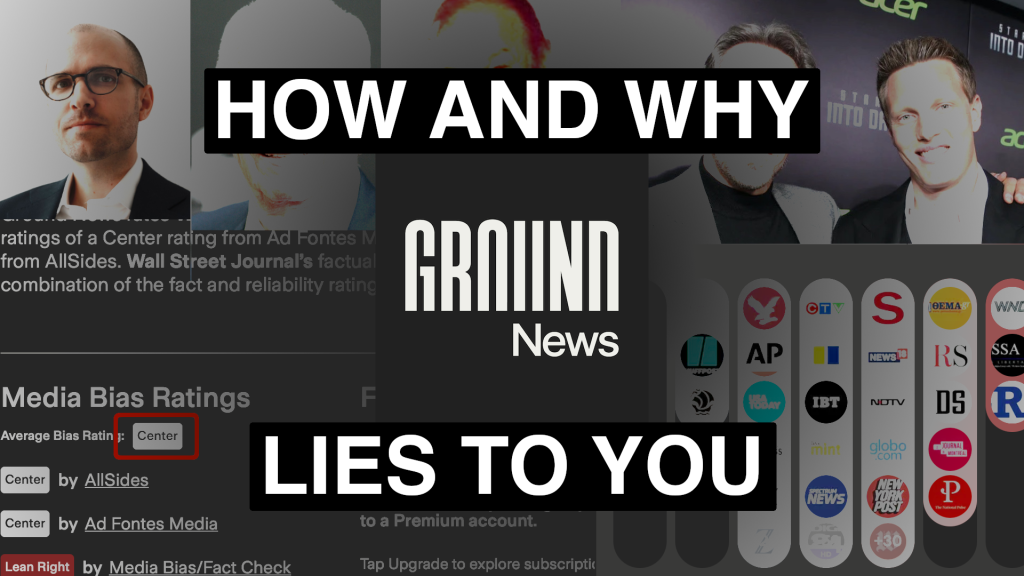
Hi! Do you have a problem with getting your news from only one side of the political spectrum? Are you being fed a never-ending doomscroll of media that only serves to reinforce your existing biases and maybe even push you into more extreme views? Well, have I got a solution for you, that’s right it’s my sponsor (not actually my sponsor) Ground News! Ground News will show you news stories like you’ve never seen them before, the same story presented from multiple news sources at once conveniently categorized by political bias, as well as showing you news stories that might be getting covered by news organizations of one political leaning but not another to help get you out of your filter bubble. Sounds great right?
Right?
Chapter 1: So What’s the problem with Ground News, Anyway?
There’s this video by Benn Jordan about how capitalism is dying, something I was researching for a certain other episode. And his video is pretty good. However, there was one part that made me do a double take. At one point in the video he says that there’s a problem that “every piece of news that the average voter sees is manipulated by a third party aggregator”. Yes, true! But then at the very end of the video he turns around and says, you know how to fix your news diet? With my sponsor, Ground News.
And I’m like waitaminute. Now, you might’ve heard of Ground News because they’ve been buying ads on popular YouTube channels faster than RayCons and Raid Shadow Legends. But Ground News is also a corporate news aggregator serving up stories via an opaque algorithm, right? And it’s not only that, but it’s a news aggregator whose chief feature is that it classifies the entirety of news output along a simple, one-dimensional left-right political axis.
Now, Benn Jordan says that Ground News is “independently owned and funded by subscribers”, but this is at best a half truth. According to their own website, in addition to subscribers Ground News is funded by an unidentified “handful of mission-aligned independent investors”, and if you look in PitchBook you’ll find a number of venture capital firms in the mix, including TechStars which was also one of the early investors in Uber.
But even if we accept Ground News’ independence at face value, how do they even determine the political bias of a news organization? According to them, it’s based on the work of three other independent organizations: AllSides, Ad Fontes Media, and Media Bias Fact Check. I could deep dive into these three orgs, the opaque nature of those involved in creating their ratings—and only Ad Fontes Media tells you the names of the people doing the ratings or what their credentials are—and the fact that they’re all, like Ground News itself, for-profit businesses, but I think it’s more telling to look at the results of their work as represented by Ground News.
One could, of course, take issue with Ground News identifying the New York Times as a publication that “leans left”, considering the many efforts its made under nepobaby owner A. G. Sulzberger’s ideals of “neutrality” and “objectivity”to buck that perception by hiring openly “anti-woke” journalists, giving voice to right-wing columnists (not to mention the famous 2020 editorial by Republican Senator Tom Cotten to “send in the troops” to put down the George Floyd protests), and causing longtime liberal economist and Nobel Prize-winner Paul Krugman to quit through editing that he said toned down his voice and forced “false equivalences” on him.
But a more concerning case I think is the Wall Street Journal, a publication owned by Rupert Murdoch’s News Corporation which also owns Fox News, and which Ground News tells us is politically in the “center” but which as far as I can tell has never had an opinion piece to the left of Francisco Franco. As I wrote this, the Wall Street Journal opinion page had such absolute center takes as “Mamdani’s socialist supermarket may put little grocers out of business” (despite the fact that they’re specifically aimed at food deserts), a piece called “The Justices are Finally Colorblind” celebrating the destruction of the Civil Rights Act by the Supreme Court, and “Obama’s Legacy is the Trump Presidency”, with the lead line, “His foreign policy was one of retrenchment, and his signature health-insurance law made things worse.” Does them implicitly criticizing Trump by blaming him on Obama make the Wall Street Journal centrist? What kind of a bad joke is this exactly?
Or consider The Economist, another publication marked as “Center” by Ground News and which, for example, recently had a cover story about how best to fight “Gen-Z Socialism” which it portrayed as a “me-first doctrine” and a “threat to prosperity”. Or Forbes magazine, which literally has a “billionaires” section and whose articles include such nuanced takes as one in June by the magazine’s billionaire nepobaby owner about how California’s Wealth Tax is “part of a tyrannical scheme for global economic control” by people who don’t understand that economic growth is limitless, something I debunked in another video. That’s definitely “Center”, according to Ground News. What do you think “center” is supposed to mean here, exactly, and who benefits from defining it this way?
And while there’s long been a distinction between the news and opinion sections of newspapers and even news-related television programs, this isn’t a distinction Ground News makes in its ratings. But then while the writers and newscasters of the two sections might be kept separate, they’re still under the same upper management and editorial policies; the Wall Street Journal leading a story about ICE Traffic Stops with quotes from Trump about their importance is a more subtle form of conservative bias than the an opinion piece attacking ICE protesters in New Jersey, but both go out under the same editorial auspices.
In fact, it sure seems like The Times feels compelled to respond to constant allegations of “liberalism” by self-consciously giving voice to the Right, while papers like the Wall Street Journal don’t bother with any such thing for the Left. Which creates a media environment designed to lurch steadily Rightward.
It’s worth noting that the notion that mainstream news organizations like the Times, ABC News, or CNN were “liberal media” was once highly controversial. In the 90s, for example, longtime ABC news anchor Sam Donaldson remarked, “People on the right say we’re too liberal and people on the left say we’re in league with the status quo, which probably means we’re right where we should be, right in the middle.” At that time, the idea that mainstream news was “liberal” was an accusation from the Right, but that didn’t mean it was accepted by the public at large, much less the newscasters themselves. Indeed, the non-partisan nature of the news was not only believed in by those reporting it, but was and remains something actively enforced by mainstream news outlets and journalism schools. Even opinion writers, who are obviously permitted to have political opinions, are not supposed to have political affiliations or be political activists.
Consider that in 2017, journalist Lewis Raven Wallace was fired from his job as a journalist on the American Public Media radio show Marketplace because of a post on his private blog averring that objectivity in journalism was dead. While firing him, his boss, veteran journalist Deberah Clark, told him a story about how she’d been scolded by a journalism professor at university for protesting Apartheid in South Africa. A journalist should be so dedicated to appearing unbiased that they can’t even be seen protesting something as horrific as Apartheid.
Which isn’t to say that mainstream media actually is or was unbiased and neutral; as I’ll explore, there’s all sorts of ways bias appears in news reports. But this stance of ostensible neutrality has long been used as a lever by a Conservative Media that seeks to portray anything to the left of far-right reaction as “liberal”, and then to frame media bias strictly in terms of a simple left-right political axis such that the “neutral” mainstream is forced to present both reality and far-right reaction in terms of equal weight, with facts themselves becoming mere ammunition in an ongoing culture war. And this once contentious framing gets presented as established fact by Ground News, or worse, served up by AI as fact based on information scraped from Ground News or its sources to a credulous public.
This rot begins, however, not with Ground News or even with the well-funded Right Wing assault on the mainstream media, but rather with the whole notion of journalist independence itself, the elaborate process in which an entire profession convinced itself it could not actively participate in the public sphere, could not be seen to have opinions on the serious moral issues of the day, and still do their job. And particularly with the redoubling of open efforts by the Epstein Class to gobble up media for its own purposes, it’s worth taking a look at how we got here and what this all actually means. And I promise by the end I’ll give you a better way to understand bias in media and where I think you should really get your news.
Chapter 2: The Birth of the News
Broadsheets of various kinds go back essentially to the beginning of the printing press, but it was in the United States in the 1830s that a number of things collided to create what we would commonly recognize today as “the news”. Newspapers existed before this point, true, but they’d essentially fallen into two categories: businessmen’s journals carrying things like what ships had come and gone from a given city, stock prices, sales and availability of various assets, and so on, with little in the way of major current events that weren’t directly related to business; or papers published by political parties or political candidates to explicitly advance their views and agenda, essentially acting as a form of propaganda. {William Cullen Bryant: Commerical Advertiser former, Albany Argus the latter} And these papers were relatively expensive at six cents each, reflecting the fact that they primarily targeted an educated elite audience. Indeed, at the creation of the United States only white male property owners could vote, so there wasn’t really a point in aiming political content at people who didn’t have much money.
However, with the beginnings of industrialism and the commercial boom in the US following the end of the War of 1812, there emerged a new, urban population, and with them a new populism that kicked against the elite order of the day and expanded voting rights to non-property owning white men. Into this environment was birthed the penny press, cheap papers that overtly targeted the working class. Funded primarily by advertising rather than political parties, these papers often proudly proclaimed their political independence and non-partisanship. In practice, this didn’t mean the facts-first “objectivism” that would come later—news stories in these papers were often highly sensationalized and the authors happy to interject personal opinions—it only meant they weren’t beholden to particular parties. And indeed, this independence allowed them to publish things that never would have been permitted by the party presses at the time. African Americans, for example, could start their own papers and speak for themselves, as physician Martin Delany and former slave-turned-orator and journalist Frederick Douglass did with their paper The North Star beginning in 1847. It was there Douglass published his famous “Fifth of July” speech, in which he wrote, “What, to the American slave, is your 4th of July? I answer: a day that reveals to him, more than all other days in the year, the gross injustice and cruelty to which he is the constant victim. … There is not a nation on the earth guilty of practices, more shocking and bloody, than are the people of these United States, at this very hour.” Because of its independence, the penny press could say things that no major political party of the time would have dared, with voices no political party at the time would’ve empowered.
Likewise between 1852 and 1862, articles by Karl Marx himself were regularly published in the New York Tribune, including his extensive thoughts on the American Civil War as it began, in which he ridiculed the Confederate cause as a “fight for the liberty of enslaving other people”, and while supporting the North also portrayed it as fundamentally a struggle between rival social systems. Thus while The Tribune at the time prided itself on its independence and non-partisanship, that didn’t mean it had any pretense of “neutrality”.
The notion that the news should not only be independent but neutral or “balanced” developed slowly, aided ironically by the rise of the ultra-sensationalist “yellow” journalism of the New York World and the New York Herald in the late 19th century which caused the remaining papers to try and further define themselves in contrast as impartially reporting the facts. It was also in this period that the separation of the “news” and “opinion” sections of newspapers began, as well as the creation of the so-called “inverted pyramid” structure of news stories, where instead of reporting events in chronological order, facts would be stated in the order of importance so that the reader could grasp the critical things right away. This inverted pyramid, though, inadvertently gave the journalist more opportunity to effectively “bias” the story than the chronological versions of events that’d come before, because the journalist has to decide which facts are the most important and can omit facts without disturbing the narrative flow.
Further, the appearance of objectivity can help portray false narratives as factual, particularly when the journalist accepts reports from those in authority at face value. Perhaps no better example of this is the case of how the endless lynching of African Americans in the American South was reported by the mainstream press in the late 19th and early 20th centuries. White Southerners and their police of course reported to journalists that these lynchings were a response to the supposed beast-like urges of black people, particularly black men who were most frequently accused of raping white women. And the newspapers duly reported them as such, the events perhaps lamentable lapses in the law but ones that were ultimately the fault of the victims. And the “just the facts” tone of the papers helped to reenforce the sense of dispassionate truthfulness.
In 1892, three African American men were murdered in Memphis, Tennessee, which the New York Times reported, per the murderers claims, as retribution for the men shooting four sheriff’s deputies. African American journalist Ida B. Wells, who had been born into slavery during the Civil War, had been friends with the murder victims and she knew what had actually happened. As she reported in her paper, The Free Speech, what the three men had actually been guilty of was opening up a grocery store that competed with a white-owned store in a predominantly black area. Whites had fired into the store, and the men working there had fired back, wounding three (the supposed “deputies” of the Times report). Following this incident, more than a hundred African American men were rounded up and arrested, and the three victims had been taken from their cells by a mob and lynched. Their grocery store, meanwhile, was looted and destroyed.
And as Wells investigated more lynchings, she discovered time and again that the accusations against those lynched had no merit. Charges of “rape” were often made after the lynchings had become public, and when there had actually been relations between black men and white women, they were invariably consensual. The lynchings, in other words, had nothing to do with the misbehavior of African Americans and everything to do with African Americans threatening white power and white supremacy.
As a result of such investigations, the offices of The Free Speech were destroyed and Wells and the other editors were driven out of Memphis.
And how did the Times, safely ensconced in the supposedly more enlightened North, respond to these revelations and to Wells’ work? In an editorial in 1894, the paper opined that rape was a “crime to which negroes are particularly prone” and suggested that the solution to lynching should be to make rape a capital offense again and speed up the judicial process to make lynching less appealing. As for Wells, she was termed a “slanderous and nasty-minded mulattress who does not scruple to represent the victims of black brutes in the South as willing victims”.
Thus it’s clear that just reporting so-called “facts” does not actually mean reporting truth, and indeed can often obscure it. But it’s also important to note that framing this bias in terms of a left-right political spectrum doesn’t actually tell you anything about its factuality. Indeed, the idea that African American men were more prone to rape than white men was something that had been so inculcated at this point that even Frederick Douglass admitted to Wells that until he read her reporting he too had been troubled by the “lasciviousness of Negroes” {Just the Facts, 182}. This wasn’t about people of one political faction having different interpretations of events than another, this was about those in power using that power to spread lies that helped them maintain that power. And it was also about how a type of journalism that positioned itself as impartial actually served only to spread those lies while another type of journalism actively motivated by the cause of social justice was able to uncover truth. And it was about how blithely and unquestioningly reporting what the authorities tell you often only serves to reenforce their power.
And to show you how little has changed, in 2014, an African American father named John Crawford III picked up a BB gun at a Walmart while talking on the phone and was shot by police and hand-cuffed while bleeding out in the aisle with his mother still on the phone listening. {View from Somewhere, pg. 25 on} The initial news story, drawing from the police report, read, “A man in a southwest Ohio Walmart store waved a rifle at customers, including children, and was fatally shot by police when he wouldn’t drop the weapon.” And it was only because the Black Lives Matter movement was in progress that the story got any additional attention and the surveillance footage from the store got released that showed what had actually happened. (Though a Grand Jury still decided not to indict the officers responsible.)
The Black Lives Matter movement was a response precisely to the same kind of phenomenon of the disposability of blacks by whites that had fueled Ida B. Wells more than a century earlier. But in modern newsrooms, the restriction against journalists being involved in activism means that non-white, male, straight, and/or cis journalists often have to choose between their careers and fighting for their own civil rights. For example, after columnist Desmond Cole protested at a Toronto Police Services Board meeting he was told by his employer, the Toronto Star, that there was a policy against activism. He resigned in protest. {View pg. 138} Transgender journalist Lewis Raven Wallace was told when he got his job in public radio that he had to stop his activities doing workshops about transgender issues and white privilege and told to steer clear of stories about LGBT issues. As if having someone who knew about a subject from direct, lived experience made them untrustworthy on that subject. {view pg. 90} And perhaps the most brazen example of where this line of thought takes you is a headline in the LA Times in 1990 that asked “Can Women Reporters Write Objectively on the Abortion Issue?” The notion of journalistic objectivity thus reinforces the perspective of the dominant status quo, which is to say white, male, straight, and cisgender, and actively suppresses the voices of those in the minority to discuss their own lives and experiences or advocate for their own rights.
Chapter 3: A Vast, Right-Wing Conspiracy
But in fact, it’s much worse than that. It was in the early 20th century, with the rise in the professionalism of journalists (including the creation of dedicated journalism schools) and influenced by the professionalism of science and its ideal of the dispassionate researcher that “objectivity” in news media cemented its dominance of the form. But at this point it’s notable that mainstream media was not typically seen as liberal but as conservative. In 1919, for example, socialist writer Upton Sinclair, whose exposing of unsanitary and dangerous practices in the meat industry had lead to widespread reforms and regulations, wrote the book The Brass Check in which he stated that whatever their ostensible political neutrality, the mainstream newspapers were organized along capitalist lines and inherently prejudiced against workers and socialism. For evidence he cited case after case where newspapers had unflatteringly portrayed strikers, unions, and socialists. Following the end of World War I, Sinclair wrote, “all the energies which were directed against the Kaiser have been turned against the radicals.” And indeed, the smattering of small-circulation socialist papers were essentially crushed in the 1920s during the first US Red Scare which had followed the Bolshevik Revolution in Russia and anarchist bombings in 1919 and 1920, inspiring widespread crackdowns on leftist organizations, unions, and immigrants. Indeed, the first reporter fired for a supposed lack of “objectivity” was Morris Watson in 1934 after he joined a union, showing how almost as soon as the notion of “objectivity” had appeared it was used to further the class interests of the paper’s wealthy owners. During the Social Democratic reforms of Franklyn Roosevelt’s New Deal, Roosevelt repeatedly criticized the “Press Lords” who owned mainstream newspapers and “made no secret of their Republican sympathies” and antipathy for the New Deal.
Meanwhile, Journalist Walter Lippmann had been in the intelligence service during World War I and had been shocked to discover how easy it was to sway public opinion. He coined the term “stereotype” in its modern usage to explain how journalists and people in general could be relied on to know about things in their direct experience, but for anything outside of it would fill in context based on their own prejudices and presumptions. He also coined the term “the manufacture of consent” to describe the way in which those in power could mold public opinion to their own ends. As a solution, Lippmann said the public needed objective facts. As he wrote, “There is no prospect, in any time which we can conceive, that the whole invisible environment will be so clear to all men that they will spontaneously arrive at sound public opinions on the whole business of government. … But we can steadily increase our real control over these acts by insisting that all of them shall be plainly recorded, and their results objectively measured.” These conclusions led him to a low opinion of the public at large and a high opinion of educated experts to make decisions and advise leaders.
But as the Second World War came to an end and the welfare state, regulations, and high taxes on the rich of the New Deal solidified as a status quo challenged by neither major US political party, many outside of them saw the hand of out-of-touch technocrats at work manufacturing consent. And they desired to manufacture a consent of their own.
In the year 1953, wealthy textile heir turned publisher Henry Regnery gathered a group of likeminded publishers, editors, and writers in a room, including William F. Buckley Jr., Frank Hanighen, Raymond Moley, and John Chamberlain. Regnery told them, “The side we represent controls most of the wealth in this country. The ideas and traditions we believe in are those which most Americans instinctively believe in also.” Why then, he wondered, was FDR-style liberalism ascendant even with the election of Republican president Dwight Eisenhower? It was because, Regnery said, “the left controlled the institutions: the media, the universities, the foreign policy establishment.” Therefore what was needed was a “counterintelligence unit” to fight back agains these “elites” domineering a system they felt they should rightly control.
Of course, what Regnery saw as the “left” was not what Sinclair had seen as the “left”. Indeed, America was now deep in the Cold War and at that very moment in the throws of McCartheyism and the Second Red Scare, where people were being blacklisted for having ever been involved with any socialist organization. And the tide was already turning against unions, with the Taft-Hartley Act of 1947 which limited strikes and outlawed closed shops that only hired unionized workers, fundamentally undercutting worker power.
And while McCarthy would be ultimately denounced, the idea that America was devoted to capitalism and anticommunism along with New Deal and Keynesian policies had become a fundamental part of what Arthur Schlesinger Jr. in 1949 called “the vital center.” Regnery, though, drew on a fierce and highly moneyed group that had long chafed at the taxes, regulations, and public projects of the New Deal to fund his media projects. Among his donors and supporters were textile magnate Roger Milliken, mining company owner Walter Harnischfeger, Sun Oil president J. Howard Pew, Herbert Kohler of the Kohler Company, oil entrepreneur Fred Koch, Robert E. Wood of Sears, Roebuck, and many others. And what they would do with their money was craft an entirely new media ecosystem more sympathetic to their interests.
The network of publications and broadcasting operations that would blossom would include Human Events, Regnery Publishing, The Manion Forum, The National Review, analysis, American Mercury, American Opinion, The Dan Smoot Report, The Freeman, and The New American, among many others, as well as existing publications that turned hard right like Robert R. McCormick’s Chicago Tribune. And this network would take for itself the mantle of “Conservative” and label most everything else as “liberal”, in some cases to the horror of more traditional, moderate conservatives. As I explored in How Conservatives Become Fascists, historically the conservative movement going back to Edmund Burke (1729-1797) had defined itself as defending the status quo and thinking change should happen slowly and carefully, while by contrast this New Conservatism was more properly described as Reactionism, an effort to actively and swiftly move things backwards to the state they were before the New Deal (if not in some cases to before the Civil War or even before the Enlightenment). Historian Richard Hofstadter would dub this “The Psuedo-Conservative Revolt” in 1954, but it was no use, “Conservative” is the label these reactionaries would be known by and continue to be known by today.
The mainstream met this new media ecosystem at first with mockery. For example, William F. Buckley’s first book, God and Men at Yale (1951) published by Regnery with help from a generous grant by Buckley’s rich father was written of in Saturday Review with the words, “This book is one which has the glow and appeal of a fiery cross on a hillside at night.” But as the movement proceeded, the mockery quickly turned to alarm. In a 1962 speech, John F. Kennedy warned against extremists looking for scapegoats who would “find treason in our churches, in our highest court, and even in the treatment of our water.” This last was a particular reference to the John Birth Society, which published American Opinion and which gleefully spread conspiracy theories including the idea that fluoridated water was a Communist plot (a notion also later parodied in the dark comedy film Doctor Strangelove (1964)). The John Birch Society’s founder, candy mogul Robert Welch, owned substantial shares of Regnery Publishing, and Regnery had published Welch’s The Life of John Birch (1954), the book from which his society got its name. (Indeed, Welch and his society’s writings were so outrageous they became a source of controversy within the movement, with William F. Buckley in particular hating Welch though they were both connected to Regnery.)
However, these Conservatives were already moving into the mainstream. The first hint of how far they’d come was the nomination of one of their own as Republican candidate for president in 1964, Senator Barry Goldwater, author of the smash hit The Conscience of a Conservative (1960). Walter Lippmann wrote in shock of the candidate’s “unworldly divorce from reality” and worried that his victory would “rupture that cohesiveness around the moderate center which is the special genius of the American party system.” And while Goldwater lost in a landslide (his slogan, “In Your Heart You Know He’s Right” was lampooned by the opposing Johnson campaign as “In Your Guts You Know He’s Nuts”), his nomination augured things to come, particularly as actor Ronald Reagan first entered the political stage by campaigning for Goldwater. Reagan would soon after pen his own book for the conservative media ecosystem, The Creative Society (1968).
Meanwhile, Australian Rupert Murdoch inherited a newspaper company from his father in the 1950s and began buying up other papers in Australia and soon New Zealand and using them to influence local politics. He expanded to the UK in the 60s, culminating in his purchase of the storied Times of London, the British paper of record. And in the 70s, he expanded to the United States, where he bought the tabloid the New York Post and changed it from left leaning to an extremely right wing paper.
In 1971, soon-to-be US Supreme Court justice Lewis F. Powell wrote what’s known as the “Powell Memo”, reacting to the social movements of the 1960s by complaining about attacks on the free market from “the college campus, the pulpit, the media, the intellectual and literary journals, the arts and sciences, and from politicians” and especially from “the media”, which is to say the liberal media. Powell complained of “biased” textbooks that had been rewritten by the Civil Rights movement, labor unions, and “other interested citizens groups” and recommended the “balancing” of faculties on campus and “monitoring” of the media, especially television, and that news stands should have attractive, well-written paperbacks and pamphlets representing, as he said, “our side”.
The Powell Memo helped inspire a new generation of the wealthy to become involved in the movement. The owners of the Earhart and Smith Richardson foundations were moved by the memorandum to merge their orgs with the conservative Carthage Foundation, which had been founded in 1966. And existing conservative organizations and think tanks like the Mont Pelerin Society, the American Enterprise Institute, and the Center for Strategic and International Studies were joined by a bewildering number of others including the The Manhattan Institute, The Cato Institute, The Federalist Society, The Reason Foundation, The Business Roundtable, The American Legislative Exchange Council, and most successful of all, The Heritage Foundation, almost all registered as non-profits and able to suck up the money of the rich as tax write-offs while serving to lobby for the rich’s tax breaks. And these organizations would attract many times more money than similar liberal organizations. Between 1992-1994 alone, for example, conservative institutions attracted $210 million while comparable liberal institutions drummed up a mere $18.6 million. (As for actual socialist organizations, there were hardly any left.) As should be obvious, for the most part, the really wealthy dramatically more conservative than everyone else.
The movement finally arrived at the White House with Reagan on the back of slogans like “the government is not the solution to your problems, the government is the problem”. Reagan told crowds that “The National Review is to the offices of the West Wing of the White House what People magazine is to your dentist’s waiting room.” Human Eventswas billed in turn as “the President’s favorite newspaper”. {Messengers of the Right, pg. 246} And Reagan had immediately gone to work implementing the Conservative Movement program, slashing taxes on the rich to levels not seen since before the New Deal, eliminating regulations and permitting media conglomeration, destroying unions, and attacking anything that wasn’t in line with Conservative (which is to say, reactionary) notions of tradition and morals. He also eliminated the “fairness doctrine”, which essentially had specified that broadcast media needed to present both sides of controversial issues, and this paved the way for an explosion of right wing radio. (The Fairness Doctrine had never covered cable TV so it’s not accurate to credit its elimination for the creation of Fox News and the like.)
And the Conservative Movement was just getting started.
Chapter 4: Objectivity As A Weapon
When the Right accuses the mainstream of being “liberal”, the accusation stings precisely because the mainstream media takes pains to establish its own neutrality and independence as a sign of legitimacy. And when those accusing the media of being biased are the same magazines, newspapers, radio shows, and television favored by the president of the United States, you start thinking maybe you’re not as neutral as you think you are. On top of this, most journalists are of a certain background, college educated and tending to come from wealthier upbringings, working in the urban centers where most news organizations are based (a problem that’s only gotten worse over the past few decades with the mass shutterings of local newspapers). (They also, as pointed out in Chapter 2, tend to be predominantly white and male, but obviously that wasn’t an issue for the Right.) And so it was easy for the Right to portray the mainstream media as rich elites from liberal cities who saw everything through a liberal lens. This, of course, despite the fact that most of the people in the Conservative media had similar backgrounds, much as William F. Buckley went to Yale and lived in New York City with a second house in Stamford, CT after marrying a wealthy heiress. Not exactly a man of the people. And of course as mentioned the Conservative movement is heavily funded by the ultra-wealthy. But this is how it always is with the Right, they position themselves as champions of the common man against the elites while simultaneously pursuing policies to undermine, disempower, and impoverish that same working class at every turn.
And part of the Right Wing program is to actively undermine the basic facts that are supposed to form the core of the objective, neutral approach to the news whenever those facts contradict the aims of the wealthy and powerful and of established social hierarchies. For example, man-made climate change is an established fact evinced by an almost unanimous scientific consensus, but it jeopardizes the business interests of oil companies, who’ve undergone a strategy (known as the tobacco industry playbook for how it was pioneered by tobacco companies) of funding fraudulent studies saying climate change was a hoax, spreading disinformation and doubt, and lobbying the government to prevent any legislation that might limit oil production or favor renewable energy. And so man-made climate change (and a host of other things) transition from facts to politicized points of contention. And when the mainstream reports facts as facts, it merely becomes evidence of their supposed “liberal bias”. (And this is also why the saying “reality has a well known liberal bias” makes sense.) And thus mainstream news organizations, in order to maintain their carefully honed appearance of neutrality, start to refer to well establish facts in ways that frame them as debatable, to “teach the controversy” as Creationists are fond of saying. But if you present “both sides” of an issue where one side is factual and the other side is fraudulent, if you try to be “even handed and fair”, all it does is legitimize the fraudulent position. And this is even more true when the lie comes from someone in a position of authority and you report it in a neutral way in deference to that authority. As Gonzo journalist Hunter S. Thompson once remarked, “How can you be objective about Nixon?” Indeed, journalists bend over backwards to make the idiot ramblings of Donald Trump seem like normal, rational statements in a desperate effort to preserve the impression of unbiased non-partisanship.
Meanwhile, per Messengers of the Right: Conservative Media and the Transformation of American Politics by Nicole Hemmer even when, say, the New York Times criticizes a liberal policy, “conservative media activists presented it not as evidence of the paper’s even-handedness but as evidence of the policy’s failure. Even the liberal New York Times had to admit… Thus evidence that seemed to undermine the charge of liberal bias could be reinterpreted to support it.” And the end result is that the news media lurches self-consciously rightward in order to avoid being called liberal, gets called liberal anyway, and makes another lurch rightward.
For Conservative Media, though, facts aren’t facts at all but signifiers of alignment, which side of the culture war you’re on. Is it our side that’s good or their side which is evil or even, for the fundamentalist set, Satanic. An interesting example of how this works is the case of David Brock. The confirmation hearings of Conservative Supreme Court Justice Clarance Thomas in 1991 were riven with controversy when Antia Hill, who’d worked under him at the Department of Education, accused him of sexual harassment. Conservative writer David Brock wrote an article called “The Real Anita Hill” that became a best-selling book in which he made a parade of lies and mischaracterizations of her that played upon racist and sexist stereotypes about black women. When the article (in the magazine American Spectator) was featured on the Rush Limbaugh show, circulation of the magazine tripled, leading to the editor asking Brock if he could find some more women to attack. Brock later had a Face Turn away from Conservatism and disavowed his earlier work, saying he’d been “a witting cog in the Republican sleaze machine”. As he describes, there were no efforts at all by American Spectator or his book publisher, Free Press, to fact check any of the things he said about Hill. In his later book, Blinded by the Right (2002), he calls the article and book “almost the precise opposite of the truth” and discusses how in twelve years of Conservative journalism, he’d never once been fact-checked. As conservative writer Matt Labash later said in an interview, “We’ve created this cottage industry in which it pays to be un-objective… It’s a great way to have your cake and eat it too. Criticize other people for not being objective. Be as subjective as you want. It’s a great little racket.” The point, after all, isn’t to tell the truth. The point is to win a war.
And the battlefields of the war were only expanding. In 1984, Rupert Murdoch purchased the media conglomerate 20th Century Fox. The following decade, the success of Ted Turner’s 24-hour news network CNN gave him the idea for a competitor.
It’s perhaps forgotten now how Fox News marketed itself following its founding in 1996. Fox News loudly declared itself to be “Fair and Balanced”. “We Report, You Decide” said the advertisements. Unlike those other news organizations, Fox was going to deliver just the facts unmuddied by that pesky liberal bias.
Except, of course, this was an obvious lie. Fox News gleefully rammed and continues to ram right wing talking points and opinion shows down the throats of every viewer 24-hours a day. But it was just the most obvious example of the methodology of portraying Conservativism as “neutral” and everything else as “liberal”. There was actually one show that attempted a kind of “crossfire” thing with a conservative and liberal discussing current events called “Hannity & Colmes”, except the liberal Alan Colmes seemed to have been handpicked to be a meek and unconvincing punching bag for the boisterous conservative Sean Hannity. Moreover, as shown on similar shows of the period like ABC’s This Week with liberal George Stephanopolis and conservative George Will, the liberal figure’s desire to come off as fundamentally fair-minded and reasonable led him to simply grant more territory to the conservative figure which the conservative felt absolutely no compunction to reciprocate. And in 2009 Fox finally dropped the pretense of offering a liberal counterpoint and sent Colmes packing.
And this strategy of the Right to say “meet me in the middle” and then take a step back paid enormous dividends.
Even before the rise of Fox News, the Reagan Revolution had already poisoned the well to the point that the Democratic candidate in 1992 ran on such left wing positions as private school vouchers, opposition to illegal immigration, limiting welfare, and limiting government spending. (And indeed, as Eric Alterman points out in What Liberal Media? (2003), Clinton’s policies were actually largely to the right of most Western European conservative politicians at the time.) But when Clinton won the election, the Conservative media went to work portraying him as a radical leftist and pounced on the slightest missteps to transform them into news stories in the supposedly liberal media that would burn for months. And the conspiracism that had characterized the John Birch wing of the movement fully matured into a tool for spreading mass doubt and misinformation, for example whipping a bad business deal Clinton had made in 1979 into an elaborate and entirely fabricated tale of murder and mayhem that resulted in Congressional investigations. This, of course, was the “vast, right wing conspiracy” that Hillary Clinton was ridiculed for accurately describing. And all this culminated with the transformation of a genuine infidelity into an elaborate circus and impeachment trial. During Senator John Kerry’s presidential bid against George W. Bush in 2004, the phenomenon of the Right manufacturing these sorts of controversies during an election got a name: “swiftboating”, based on political ads that brazenly lied about Kerry’s performance on swift boats during his service in Vietnam.
And the strategy of sacrificing all semblance of factuality, policy-making, or governance for the sake of political power blossomed during the Obama years, particularly following the astroturfed “Tea Party” movement, driven by Fox News hosts like Glenn Beck (since Conservative Media imposed none of mainstream media’s restrictions on activism) and massively funded by billionaires like the Koch Brothers, and that succeeded in largely drumming out moderate Republicans and those willing to compromise across the aisle. Mitch McConnell stated openly that their main priority as a party should be not governing well but merely ensuring Obama did not get a second term, and thus apart from a brief moment when the Democrats clung to a bare supermajority in the Senate, Congress essentially ground to a halt, refusing to pass any bill that might make it look like the administration was accomplishing anything at all. And all the while portraying Obama as a radical Marxist and even the actual antichrist on 24-7 blast, a figure in reality so “extreme” that he personally shot down the option of universal public health care in a deal with the for-profit hospital industry, something most developed countries take for granted and which a majority of Americans support, in favor of a market-based compromise first pioneered by his former Republican opponent Mitt Romney.
(And I know I focus on the US here but obviously this is not only a US phenomenon, for example in Italy you have Burlesconi owning all the TV stations helping to propel him to power, and in Russia the idea that the “truth” is whatever those in power say it is is practically state doctrine, and so on.)
Meanwhile, the conservative media ecosystem continued to grow, with the right-wing Sinclair Broadcast Group taking advantage of deregulation to buy up television and radio stations across the country, websites like the Drudge Report and Breitbart being joined by media organizations like the Daily Wire and Blaze Media, and television channels popping up that made Fox News look positively liberal, like the The One America News Network and Newsmax. And the billionaires funding these Conservative efforts were revealed in 2024 to have been joined by massive amounts of money from Russia.
I mean, when you look at all these conspiracies about George Soros secretly funding everything on the left, what you’re actually seeing is projection, part of the cliche that every accusation from the Right is a confession. Because everyone I think knows that all the supposedly “grassroots” right wing activism is astroturfed by billionaires and that Russia and others have an army of internet monkeys and bots pimping right wingers and right wing ideas throughout Western media. And they just can’t believe that this isn’t the case for the other side. But, of course, as Upton Sinclair pointed out a century ago, mainstream media is also owned by-and-large by rich people, which of course is another thing that makes them susceptible to right-wing drift and to belittling unions and socialists. AG Sulzberger of the New York Times, has a lot more in common in terms of class interests with Rupert Murdoch than he does with you and me.
Trump, in fact, understands perhaps better than anyone how to use the media to his advantage. He’s spent his political career painting the news media as the “enemy”, throwing their accusations of “fake news” back at them and framing himself as a font of truth while compulsively lying about almost everything. Meanwhile, his every outrageous action only creates more coverage, more attention for him and his ideas, while the constant accusations of bias force the media doing the coverage to frame his every outrageousness in the cloak of normality. Much as with Nazi antisemitism, the truth of the matter is always besides the point. You espouse the lies not because you believe they’re true but because the lie is a signifier of ideological identification. It’s part of the “team” you’re on, and to contradict it is to empower the enemy. For him and Conservatives what matters isn’t truth, it’s power. And in particular, the power of the Epstein Class to drum out any last vestiges of both the democratic and technocratic oversight in order to enhance the vast concentrations of wealth enabled by the private ownership of capital. And the result is that now we’re witnessing the Conservative Ecosystem swallowing up the mainstream one altogether, most obviously exhibited by billionaire Larry Ellison buying Paramount and putting Bari Weiss, head of the Conservative The Free Press, in charge of CBS News, and now also finalizing the purchase of Warner Bros and with it CNN.
Chapter 5: Ground News as a Tool of the Ruling Class
Which brings us finally back to Ground News and what it actually signifies and where you should actually be getting your news.
Ground News promises to be the antidote to news bias and the influence of the powerful, but all it actually does is reinforce it by framing every news story as a battle between left and right points of view, which encourages the notion that reality itself is just a matter of political affiliation. And it makes this determination based on supposedly impartial sources that have already been coopted to the point where they’ll tell you the Wall Street Journal, the Economist, and Forbes are in the political center.
And consider for a moment who this service is aimed at? Who are their potential customers? This seems to be aimed at people who want to see themselves as clear-eyed and rational, and who’ve bought into the notion that being clear-eyed and rational means examining both sides of an issue with equal circumspection. Maybe even people who consider themselves leaning conservative or liberal (but probably liberal) but who are still concerned about the effects of “filter bubbles” on their news diet, and are thus susceptible to the notion that news media slots well into a one-dimensional political scale. And so they’ll come to Ground News, which will reinforce the idea of news being defined by political allegiance and thus aid the larger campaign of legitimizing right-wing framing and pushing the Overton Window rightward.
If I were conspiratorially minded I’d say Ground News itself is a right wing psyop, but really it doesn’t have to be. There doesn’t need to be a secret conspiracy to achieve what’s been done out in public for all to see. The people who make Ground News may genuinely believe they’re doing a service for their customers, even as they’re actually just more useful idiots for the ruling class.
Because here’s the thing. The fundamental lie undergirding all of this. News that tries to be neutral and objective is actually bad. An appearance of neutrality and objectivity, as I think I’ve shown at length here, serves primarily to reinforce the status quo and position the biases of the media as bare truth, making it easier for political actors to manipulate what the truth means.
But the filter bubble isn’t the real the problem. It’s the mainstream media ecosystem itself. What you actually want, what you actually need isn’t Ground News. No, what you actually want is a news media that isn’t in service to the Epstein Class and their objectives, that isn’t vulnerable, or at least less vulnerable, to the pernicious influence of wealthy business owners and their predilections. No, I don’t mean non-profits, at least the way those are typically organized their boards and funding come from the same rich people who own all the businesses. And no, I don’t mean public media, which anyway hardly exists in the US anymore, and which we’ve seen all too well can easily be coopted by Conservative politicians as with the BBC in Britain. Hey, remember when I said in all those videos that socialism doesn’t mean government control, it means worker control? Well, this is why. And that’s right, if you’ve seen my other videos you probably know where this is going. It’s worker cooperatives. Media companies owned by journalists themselves and answerable to no one else.
And while the journalistic apocalypse that’s unfolded over the decades since the arrival of the commercial internet and the rise of private equity has been terrible for journalists as a whole, those laid off by corporate media have now formed a large number of excellent news cooperatives, including 404 Media, Defector, Aftermath, RANGE Media, Hell Gate, Flaming Hydra and many, many others. Find some that speak to you and subscribe. That’s the only place you’re going to be able to find news that isn’t suborned to the desires of the wealthy few, that isn’t pretending that news stories have no moral weight, or that it’s acceptable to objectify the horrific.
As I’ve explained at some length before, worker cooperatives are a form of market socialism that actually empowers workers and in addition to being good businesses, are a key part of a larger strategy to build economic power outside of the forces of capital.
And this really is the only way around the whole “manufacture of consent” thing. Because for all the undemocratic conclusions Lippmann draws from his observations about how public opinion can be swayed, he’s not wrong that public opinion can be swayed. Still, this doesn’t mean that, as some Marxists would have it, the moneyed interests have absolute control within the framework of liberal democracy. Despite all the propaganda of moneyed interests arrayed against them, the majority of the American public actually supports progressive policies when asked about them. Likewise, the rise in the popularity of socialism in the United States over the past decade despite capitalism practically being on holy ground here shows just how hard it is for the Epstein Class to get people to fight against their own interests when it feels like everything is collapsing around our ears. In fact, in some ways Conservative Media has inadvertently been good at promoting socialism by constantly portraying things that people desperately want like public health care and child care and so on as “socialist”.
The way we fight isn’t with tools that grade news bias according to a scale actively used to manipulate and mislead us. The way we fight is by supporting organizations that that don’t exist for the profits and propaganda of the ownership class.
Now, it’s certainly nice for the various YouTube channels to have Ground News pouring VC money on them in exchange for sponsorships, and I want to be clear I don’t blame those channels for not understanding why they shouldn’t take Ground News’ premise at face value. I’m definitely not calling out any particular channels here for accepting sponsorships, especially since I know how hard it is to make any money doing this nonsense. But Ground News is ultimately a pernicious force that, intentionally or not, serves the interests of the ruling class. And especially since alternatives are available, we should grab them with both hands.
Thanks, that’s it! It’s funny I said I was going to make shorter videos, maybe with less research, ha! Ha ha! Apparently, I can’t help myself. And since I’m not getting that sweet, sweet Ground News money, please feel free to support me at Patreon.com/ericrosenfield where you can get early, ad-free episodes, exclusive authors notes and more for only $1. Actually, man, I wrote a whole chapter about Walter Lippmann that I took out because I thought it was too much of a digression, but that guy the more I learn about him the more I feel like he’s one of the secret figures who shaped the 20th century. I mean the conference where the term “neoliberal” was coined was the Walter Lippmann Colloquium! So I put that chapter up on Patreon with this video, sign up and check it out!
And thanks to all my Patrons who help make this work possible.
Bibliography
Books
- The View from Somewhere: Undoing the Myth of Journalistic Objectivity, Lewis Raven Wallace, 2019
- Messengers of the Right: Conservative Media and the Transformation of American Politics, Nicole Hemmer, 2018
- Just the Facts: How “Objectivity” Came to Define American Journalism, David T. Z. Mindich, 1998
- What Liberal Media? The Truth About Bias and the News, Eric Alterman, 2004
- Discovering the News: A Social History of American Newspapers, Michael Schudson, 1981
- News with a View: Essays on the Eclipse of Objectivity in Modern Journalism, Edited by Burton St. John III and Kristin A. Johnson, 2012
- The Brass Check: A Study of American Journalism, Upton Sinclair, 1919
- Public Opinion, Walter Lippmann, 1922
Videos
Articles
- Times publisher A. G. Sulzberger on independence and neutrality in the media
- Times’ “anti-woke” reporting
- Paul Krugman on how the Times toned down his voice and forced false equivalences on him
- Lewis Raven Wallace on the death of objectivity in journalism
- The long history of the war over the term “conservative”
- The Powell Memo
- The really wealthy are dramatically more conservative than everyone else
- How the Reagan administration permitted massive media conglomeration
- Obama personally shot down the public option for health care
- More about journalist cooperatives
Find Some News Coops