
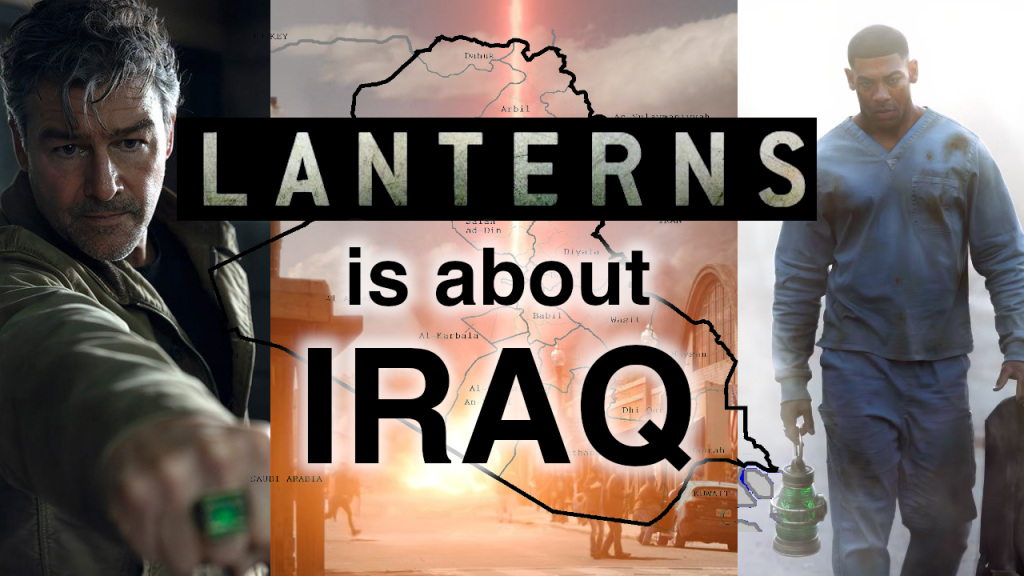
Warning: Spoilers aplenty for Lanterns (2026)
When comic book writer Tom King pitched the TV show Lanterns to DCU head James Gunn, the logline was “True Detective with Green Lanterns”. And you can see why Gunn went for it, it’s the kind of idea that once you hear it just seems like it has a lot of juice. In the comics, the Green Lanterns are an intergalactic police force and, particularly given the absurd popularity of crime drama on television, in seems fitting to adapt the Lanterns for television by putting them into the format of one. Plus, one of the comics’ most iconic storylines is one where the Green Lantern (Hal Jordan) travels across the country with Green Arrow dealing with “grounded”, down-to-earth social problems, which suggests how a more grounded crime drama approach to the character could work. And True Detective specifically is an iconic “peak TV” show that deconstructs the crime drama by forcing its troubled heroes to confront the question of whether what they do has any meaning. There’s just a lot you could do with that set of ingredients.
But unlike True Detective, what Lanterns does is less focus on crime and policing than imperialism, using the premise to explore themes like proxy wars, how imperialism impacts the communities it touches, and the people who struggle to live with the consequences. And while the series is consummately well made and compulsively watchable, both the superhero frame and the need to focus on our problematic heroes in some ways undermines those themes in ways that brings to fore troubling subtexts.
But I’m getting ahead of myself. Before we can talk about that, we have to talk about show creator Tom King and the fact that before he was a TV writer, he was a comic book writer, and before he was a comic book writer, he was a CIA counterintelligence agent in Iraq.
Tom King graduated from Columbia University in New York City in the year 2000, after which he interned at Marvel Comics (also in the City) hoping to work his way to his long-time dream job of being a comic book writer. There he assisted the legendary Chris Claremont, who famously revamped X-Men comics in the 70s and 80s and turned them into the popular powerhouses they’re still today after years of being an also-ran, third tier team. However, this was the period before the launch of Marvel Studios and the success of Iron Man (2008), when Marvel was struggling financially (they’d actually gone bankrupt in 1996) and before long they’d laid off not only King but Chris Claremont too and lots of others.
Struggling to remain in the industry, King decided to go back to school to study law. And he was still in New York City when it was attacked on September 11th, 2001, an event that radically reordered his priorities. And so it was that King decided to join the CIA where he would come to work in counterterrorism in Iraq. Seven years later, he retired from the service following the birth of his first child, published a novel, and then drew on his connections from his internship days to finally get into comics writing where he quickly became a major star.
King’s time in the CIA has often been used as part of his marketing—his comics billed as being “written by a former CIA agent”. But of course, he hasn’t actually talked much about what he did in the service since, you know, it was the CIA. He said at one point that they wanted him to go under cover as a chemistry professor but he rejected that and chose instead to pretend to be a comic book writer, since he didn’t know much about chemistry but knew plenty about comics. He’s said that he used to run agents into terrorist networks to disrupt their progress (and hilariously compared this to what Trump is doing in the presidency). And he has described having been in the room with George Tenet, the head of the CIA at the time, when the invasion of Iraq first went underway and described it as them being “very proud of this awful thing they were about to do”, so he seems to not be so fond of the ultimate results of the war. (In fact he said that he thought the war was the “stupidest fucking thing”.) (And ironically, while left-wingers hate King for having been in the CIA, right wingers often hate him too for generally being a liberal who hates Donald Trump and puts just terrible things like anti-sexist and anti-racist material in his comics.)
But there’s good reasons not be super thrilled by King’s association with the CIA. The CIA, you see, is bad. No, I’m not going to equivocate that, it’s… it’s just bad. Among it’s greatest hits is a long tradition of overthrowing democratically elected governments that were not seen as friendly to US interests and replacing them with brutal, right-wing dictatorships as they did in Iran, Chile, and Guatamala (where they literally overthrew the government in the name of US fruit companies, part of a trend of such coups that gave rise to the term “banana republic”). And in general, since its founding in 1947 the CIA has consistently worked with little regard to what might be in the interests (or public will) of anyone other than the US government and businesses, particularly not the people of the countries in which they meddled. And of course ironically given the two wars the US fought against him, the CIA also helped to bring to power Saddam Hussein, the leader George W. Bush would later compare to Hitler.
And not only was the Iraq War undergone based on CIA information that the country had weapons of mass destruction that turned out not to exist, but the organization made headlines for reports of abductions (known as “extraordinary renditions”) of people to secret “black sites” where they were often subject to torture. (At the time this resulted in a seemingly unending effort by the press to “investigate” whether waterboarding actually constituted torture (spoiler alert: it does)). And they were involved in the notorious Abu Gharib torture and prisoner abuses that became something of a synecdoche for all the rampant illegality and immorality going on in a war that resulted in the deaths of hundreds of thousands of civilians, a war undergone over Weapons of Mass Destruction that never existed, and in the name of a terrorist attack the country in question had nothing to do with.
Now, there’s no evidence that I’m aware of that Tom King was specifically involved in torturing or kidnapping anyone. The closest we have to anything like that is a panel where King mentions that one of the problems with Batman’s signature move of holding someone dangling upside down off a building to get information out of them is that it doesn’t actually work. And while some have jumped to the conclusion that this means he actually tried this with some alleged Iraqi insurgent, of course it doesn’t necessarily mean that. He could easily have been told by someone else that this sort of thing doesn’t work. Indeed, since the rampant and unconstitutional tortures by the American government became public during the war, there’s been an upsurge in literature about how torture in general is actually a terrible way to try and get information out of people, despite its ubiquitous use in film, television, and comic books.
But what we do know is that Tom King likes writing stories in which the concept of heroism itself is deconstructed, where heroes are portrayed as flawed and complicated, their actions having terrible, unforeseen consequences, and everyone, just everyone, is dealing with horrific trauma and PTSD, often from their own actions. So, while we don’t know what exactly Tom King did or went through, it’s probably pretty safe to assume he’s seen some shit.
And of course while it’s tempting to view the entirety of Lanterns through the lens of King since he first proposed it, helped create it, and worked on it, he was not the showrunner (that was Chris Mundy, who actually wrote for True Detective among many other shows) and the show was also co-created by Damion Lindelof, known for co-writing the execrable JJ Abrams Star Trek movies (yes, the first one is bad too, maybe I’ll talk about why some day) as well as working on lots of other TV shows and movies, and of course there was also a whole team of other writers involved. King is an experienced comic writer but a novice TV writer, and they probably weren’t going to make him showrunner first time out of the gate—though he is going to showrun the upcoming Mr. Miracle animated series. At the same time, it hardly seems like a coincidence given King’s background and his previous work that Lanterns has the kinds of themes and characters that it does.
But before we talk about the show itself, let’s take a short detour into the source material to see the raw clay the writers were working with.
The first Green Lantern character was a blond named Alan Scott who had magic powers and premiered in 1939 as part of the onslaught of superhero comics that came out following the meteoric success of Superman in 1938. Alan Scott’s series was canceled in 1949 as superheroes waned in popularity and he doesn’t really matter for our discussion here. The second Green Lantern character was Hal Jordan, created ten years later at the very beginning of the resurgence of the superhero genre, and befitting the popularity of science fiction in that decade, his backstory was given a complete science fictional revamp, reimagined along the lines of EE “Doc” Smith’s popular *Lensmen* novels (1937-1954). The lensmen were members of an intergalactic patrol force created by the ancient Arisian race where those selected for service were given a living “bio-jewel” called a “lens” that granted them incredible powers. And so now the ring and “lantern” that powered it from the original comic weren’t magic but alien artifacts granted by the mysterious “Guardians of the Universe” for their elite space police. Their primary criteria for membership? A complete lack of fear. Jordan though was never an interesting character, always something of a cypher, with far more interesting villains and side-characters, and he was perpetually a “b-tier” figure in the DC Comics stable.
In 1968, the series created Guy Gardner as a “backup” Green Lantern who could be brought into service if Hal wasn’t available, though he wasn’t a much more interesting character at that time either. In 1972, however, a story was written in which Gardner gets hit by a car and while he’s incapacitated, a new “backup” needs to be selected. Artist Neal Adams had the idea to make the new Lantern an African American, and (in tune with the trends following the Civil Rights movement) wanted to buck against white stereotypes by making this new character a college educated professional, in this case an architect. Still, these well-meaning white liberals of the early 70s were, shall we say, imperfect. Writer Dennis O’Neil originally named the character Lincoln Washington but changed it when editor Julius Schwartz pointed out that was a slave name. And in his first appearance, Stewart talks in an absurd kind of jive and the story revolves around Jordan assigning Stewart to protect a racist politician to teach him a lesson in responsibility. (The racist politician then tries to stage an assassination attempt in an effort to start a race war. This is part of why it’s a bit funny when people accuse Lanterns of being “woke”, like this shit has always been “woke” if by “woke” you mean having even the remotest sense of social justice and American history.)
In 1984, Hal Jordan quit being Green Lantern to spend time with his girlfriend Carol Ferris, and Stewart becomes the Lantern full time. A year later, writer Steve Englehart got the idea to have Gardner wake up from a coma with brain damage that turned him into an ultra-macho, jingoist parody of a “red-blooded American male” who believed the ring and title of Green Lantern should be rightfully his. And this gives us a natural conflict between Gardner’s cocky, self-centered idiocy and Stewart’s passionate sense of righteousness. Then, having two actually interesting Green Lantern characters, Englehart for some reason decided to also bring back Hal “wet blanket” Jordan. (He would later be killed off and unfortunately brought back yet again by the plague upon the comics industry that is Geoff John’s. But that’s another story.)
In the Aughts, John Stewart was used as the Green Lantern character in the animated Justice League TV show that spun off from the success of Batman: The Animated Series and Superman: The Animated Series. Here though, show co-creator Bruce Timm decided that his 70s “Black Panther” roots were irrelevant now and reinvented him as a no-nonsense marine, a backstory that would be retroactively given to the comics character as well. And while this is disappointing, this version of Stewart as a consummate professional, disciplined, in control, and driven by an unequivocal sense of justice, who when pushed displays the roaring emotion just kept in check under the surface, is the iconic one that still defines the character.
Meanwhile, as our relationship with authority figures changed and the comics audience matured, so did the depiction of the Guardians of the Universe, who steadily became colder and more machiavellian, as well as riven by catastrophic infighting that created rival, powerful factions and offshoots.
The 2011 Green Lantern film tried to solve the boring Jordan problem by making him a wise ass because it starred Ryan Reynolds and that’s what you do with Ryan Reynolds.
Lanterns, however, handles the issue by simply throwing out the comics version of the character and creating a new one. And Lanterns, like its inspiration True Detective Season One, works in no small part thanks to the characterizations and performances of its two leads, Kyle Chandler as an aging Jordan and Aaron Pierre as his trainee Stewart. Both actors are magnetically watchable and even better playing off each other than they are on their own.
And perhaps the cleverest thing the show does is deconstruct the notion of “fearlessness” as being what makes you worthy of the ring. This Hal Jordan’s fearlessness is revealed to be the result of chronic depression, a condition handed down from his father who committed suicide, and which drives him to keep people at a distance and not have any loved ones who might get hurt or make him afraid for someone. Meanwhile, before Jordan was chosen, the ring first contacted John Stewart’s father but passed over him because he admitted fear, and Stewart senior’s life is ruined by the sense of what might have been and the fact that no one believes him. At least until a Guardian, played by Laura Linney having an absolute blast in the role of a morally ambiguous alien, visits Stewart’s mother, expresses regret for the effect the ring had on her husband’s life, and suggests that the baby she now holds might make a good Lantern one day, if he can be made fearless. Stewart is thus raised having apples routinely shot off his head and being stranded in bad neighborhoods and having to find his own way home, and told that one day he will be a Lantern and also that the birds are watching him on behalf of the Guardians at all times (a lie to make sure he performs well). He ultimately becomes a Marine sniper despite really wanting to be an artist.
“Fearlessness” of course is really a childish thing to singularly pin worthiness for a peacekeeping force to, especially in place of things like, say, ethics, integrity, sense of duty, and any number of other qualities we might also say you’d want in such people. In fact, it’s the sort of thing someone puts in a comic book aimed at children published in the 1950s which allows a child to imagine that maybe they too have the kind of fearlessness necessary to wield the ring, aiding the power fantasy at the heart of the superhero genre. But with Lanterns, the fixation on “fearlessness” makes the Guardians seem all the more alien and uncanny, with Stewart’s mother upbraiding them for expecting oppressed people to be fearless in maybe the most fascinating exchange in the series (and one written by a black woman, Vanessa Baden Kelly, which helps explain why the whole episode has a texture of actual black experience sorely missing from, say, O’Neil and Adam’s original John Stewart story).
And I also can’t help given the context of the rest of the show but think of the kind of people who become Lanterns here in terms of the all-volunteer army that went into Iraq, including scores of mercenaries. What kind of person chooses work like this? Some must have been raised to be warriors like John Stewart, people for whom a sense of duty is part of their identity. Some may have have a near-suicidal attraction to violence like Jordan. And some are certainly just cocky assholes like Guy Gardner (as we’ll see) who relish power, authority, and glory for their own sakes and for that reason are maybe the last people who should be entrusted with it. (Of course, this leaves out people who join the military because they feel like the college education granted by the GI Bill and the experience are the only way they can materially get ahead in the world, and it’s extremely notable in my mind that material economic conditions play very little role in this story.)
In the comics, before the Guardians created the Green Lantern Corps, they created the Manhunters, android peacekeepers who ultimately decided (Skynet-style) that the best way to make sure there was no evil in the universe was to ensure there were no other sentient beings. The Manhunters were ultimately destroyed, though survivors inevitably crop up to make trouble for the Lanterns and others because of course they do.
The first five episodes of the eight-episode season concern Jordan and his trainee Stewart involved in a murder investigation in which several armed men were shot at a high school football stadium in a small town in Nebraska called Rushville. As the mystery unravels, it turns out that Rushville is hiding a Manhunter and the dead men were members of a disguised alien group out to destroy it in retribution for the genocide of their people. The town meanwhile is protective of the Manhunter, because it—or she as it turns out—has been healing their various diseases and injuries, guarding their secrets, and generally looking after them.
And so, rather than a typical murder mystery with a clever criminal operating on their own or with a few accomplices, we instead have a situation much closer to the communities in Iraq and Aghanistan that protected alleged terrorists from the US and its allies, and the way those groups were often part of the basic infrastructure of and defended by local communities.
Meanwhile, the aliens targeting the Manhunter are revealed to have their key mode of attack and defense be blowing themselves up, in other words making them suicide bombers, and ones who threaten to blow up the whole town this way if the Lanterns can’t get the the Manhunter for them.
And so we can read this situation as akin to what happened in the Iraq War, where sectarian warlords ruled cities, towns, or regions and suffered terrorist attacks from rival sectarian groups, with Jordan and Stewert akin to the US trying desperately to keep a lid on the powder keg. (And with the whole situation having been created by Jordan and Stewarts bosses, the Guardians, when they created the Manhunters in the first place.)
Of course, these metaphors are hardly precise. But that’s part of their power. The Manhunter here obviously isn’t Saddam Hussain or Osama Bin Laden or such-and-such regional warlord, but by being none of them she can stand in for all of them and many others. The story can thus echo things that happened in the real world or might happen in the future in ways that give us a fresh perspective on them and allow us to question our own assumptions.
At the same time, the choices that the writers make about these metaphorical situations, about the characters and their own choices, says something about those writers worldviews and how they think about these sorts of situations and people. And the boldest of these choices is that where another, similar superhero story might have the Manhunter secretly plotting to take over the world, or exacting some terrible cost on the townspeople in exchange for their protection, in this story we get none of that. Though the Manhunter is shown ultimately to value the lives of the townspeople far below her own, all the Manhunter and the townspeople both really want, what they say they want over and over, is to just be left alone.
Jordan should tell the Guardians about the Manhunter but he doesn’t. Instead, he decides to take the law into his own hands in no small part to prove that he and not Stewart deserves the ring. And the results of that decision are disastrous, resulting in scores of deaths, nearly killing Stewart, and decisively losing Jordan the ring. This in itself is an interesting upending of the typical story about a cop disobeying orders and going it on his own, *Dirty Harry-*style, because he can’t be encumbered by pesky things like rules and accountability. Though, of course, Stewart doesn’t tell the Guardians that the Manhunter is there either because he doesn’t trust them. And we’ll get to what that might be saying in a bit.
Of course, another alternative to telling the Guardians would be to just leave them all alone as they want. Yes, Jordan and Stewert would still have to deal with the suicide bomber aliens who have threatened to blow up the town if they don’t bring them the Manhunter, but if anything that seems like an easier problem than dealing with the Manhunter herself. (Indeed, just telling the Manhunter about them might have given her enough to deal with them, considering everything we see she can do and the resources she has at her disposal.)
Saddam Hussein might not have been good, but if we hadn’t invaded hundreds of thousands of civilians wouldn’t have died and ISIS wouldn’t have existed And especially considering that the US very openly did not have the backing of NATO or the UN for the war, it’s easy to make a parallel between Jordan’s self-serving motivations and our own.
Of course, the fundamental weirdness of this whole metaphor is that no one in the series are fighting for political or economic goals. The suicide bombers aliens aren’t trying to liberate their people, their people are already dead and all they want now is retribution. Jordan isn’t fighting for resources or political control, he’s essentially just trying to bring in or bring down a fugitive. The Manhunter just wants to be left in peace, and is portrayed as having drawn the townspeople around her and gained control of businesses and weapons for the express purpose of protecting herself from the Guardians and Lanterns. The Guardians aren’t given a backstory in the series, but in the comics they simply want peace for its own sake out of guilt for their own misdeeds in the past. The closest anyone has to something that might be interpreted as a political project are the townspeople, who’s project is just to maintain the status quo and protect their leader.
No, the things driving these people aren’t material conditions. They’re personal ones. The Manhunter is revealed to essentially be suicidal out of regret for everything she’s done but unable to admit it, and uses the situation to engineer her own death. Despite this she’s willing to kill scores of townspeople to protect herself, something that the show implies comes down to her “fundamental nature” which has some uncomfortable eugenical overtones.
But really what this is about is the internal conflicts between who we’re made to be and we want to be. The Manhunter’s struggle parallel’s Stewart’s struggle with who his parents have molded him to be and who he really is. Jordan struggles between his suicidal depression with the recklessness and low self-esteem that creates and the hero he wants to see himself as and that he wants others to see him as. Even the sheriff struggles between who the Manhunter wants her to be and who she is given her own traumatic history. And we’ll see that same struggle again when we discover the second Manhunter.
And this is part of how this show is so well written, the internal struggles of the characters all echo one another and address the same themes in different ways, of characters having to choose who they are in the face of their own pasts and traumas. And this all reflects back on what the show is trying to say about Iraq and American Imperialism. That we suffered a terrible trauma on 9/11 and in responding to it inflicted terrible trauma on others who didn’t deserve it. And that we, and not just us but every country, don’t have to keep surrendering to this cycle of violence. And there’s a poetry to that. But the problem is that by making politics into personal internal struggles, it strips it of the material conditions that create those struggles and, in the fashion of Western narrative, reduces them solely to individual choices. At the end of the first five episodes, Stewart sees the damage that Jordan has wrought and what his need for the ring drove him to become, and he rejects it and walks away from the Guardians and being a Lantern. But while the Guardians may be untrustworthy, cold, and calculating, there’s no sense that maybe there shouldn’t be Guardians, or maybe the Lanterns should have some sort of civilian oversight before they go charging into a situation, or that maybe giving an individual that kind of power might be a bad idea in the first place. The system simply is, in this framework, and the best we can ever do is walk away from it.
Which actually brings us to the three episodes that make up the back half of the season. Following the showdown in Rushville, Jordan is put in prison for a decade. Stewart, having given up being a Lantern, becomes an architect, making substantial money designing bunkers and panic rooms for rich clients. Meanwhile, Guy Gardner becomes the Green Lantern of Earth, a high school gym teacher whose own fearlessness seems to stem from his arrogance and ego, qualities which presumably make him also more pliable for the Guardians than the disillusioned Stewart.
Following his release from prison, Jordan returns to Rushville, where he’s hated, to try and make amends. There he becomes romantically involved with the plucky sheriff, but is ultimately murdered, and the sheriff brings Stewart back to town to figure out what happened.
And there’s lots of fun stuff I could talk about across these episodes. Nathan Fillion is always delightful as Gardner, and he and Aaron Pierre’s Stewart have exactly the kind of mutual loathing you’d hope for with those characters. It’s a little contrived that Gardner was given a new ring while Jordan’s ring was retired given how the rings passing from one bearer to another is one of the main things we know about them, but it gives us the fun of Stewart conning Gardner into getting the ring for him and then reviving the Jordan sort-of-hologram with it. And I love the whole thing where they find the portal to the other world and find Jordan’s old mentor turned criminal Sinestro there, played magnificently by Ulrich Thomsen. I really can’t overstate how fantastic the acting is in this whole show.
But Sinestro brings the narrative to some dark places. Stewart, our hero, literally waterboards the guy for information. Granted it’s putting him in the weird fear water that made all the aliens go crazy and kill each other, but really it’s not like that’s better and the aesthetics of the whole thing are pretty clear. This is waterboarding, and in the show it’s successful and basically portrayed as a positive thing for Stewart to have done, which is particularly odd in a show that seems to have so many parallels to Iraq specifically. And then, with Sinestro shouting in protest, Stewart and hologram Jordan leave him stranded there alone on an island. So um… torture and solitary confinement are sure great things I’m glad our heroes are doing to the person they don’t like. You know, he’s a villain why do we care about pesky things like fundamental human rights.
Yeah, I found this sequence really troubling.
And at the end, Stewart makes the choice that Jordan didn’t make. He leaves the second, newly discovered Manhunter be to live his life. He doesn’t even bring the sheriff in for murdering Jordan. Instead he just brings forgiveness and understanding. And then, with Jordan’s ring and the lantern he took from Sinestro, he summons Gardner to tell him he’s taking over Earth free from Guardian oversight. (And his “Maybe you should take it from me” line is particularly badass, especially since it turns out he was bluffing and the ring had hardly any charge left.)
But this in its own way recontextualizes what Jordan did. His mistake wasn’t going off on his own like a cowboy, but merely choosing to fight instead of backing off. Going it alone without anyone to hold you accountable is apparently good, actually.
But let’s be clear, this is a superhero story. Superheroes as a genre are about the righteousness of super-powered vigilantes and when authorities try to bring them any sort of accountability and oversight, it’s portrayed as a problem that must be fought, as in Captain America: Civil War (2016). And to be fair, when Cap in that movie complains that if they come under government control they might be sent to do something they don’t want to or told not to do something they do want to, well, when your government does things like invade Iraq under false pretenses, kidnaps and tortures people at black sites, and is still funding and providing weapons to a genocidal regime in Israel, well, that’s kind of a valid concern. But the ultimate message is that the only person who can be trusted with power is the good person who isn’t inhibited by anyone that might hold them back, and as I’ve talked about before, this is essentially a fascist theme. As comic book legend Alan Moore put it, “there is a lot of fascism in the idea [of superheroes]. Somebody said the difference between Superman and a mass murderer is in fact very little—they’re both people who assume they have the power and assume they have the right to inflict their own conception of justice on the world. There is a lot of really strange morals there which are really interesting to explore.” The Green Lanterns are unusual in the genre because they’re the one set of superheroes that’s supposed to have oversight. And granted that oversight doesn’t have what we’d think of as a “civilian” component, it’s at least more than Batman has when he’s going around dressed up like a bat and punching the mentally ill. And this is where Lanterns leaves its hero, having waterboarded a man to get the source of his power and making life or death decisions entirely on his own.
But then almost everyone in this story seems to be imposing their vision of right and wrong on other people regardless of what those other people might think. The Guardians impose their peacekeeping force across the universe. Jordan tries to apprehend the Manhunter even though the people of the town tell him to leave, and then he returns to the town to stay and “help” to assuage his own guilt even though no one actually wants him there. The suicide bomber aliens want their vengeance no matter the consequences. The First Manhunter recruits and seduces the people around her for her own ends without really caring about their well being, at least not enough not to kill them to save herself. Stewart’s parents try to mold him into what they want him to be whether he wants it or not. The main difference with Stewart is that the choice he makes at the end (other than torturing and stranding Sinestro) are motivated by forgiveness and kindness instead of self-righteousness, self-preservation, or self-aggrandizement, and this becomes then the theme of the story.
We can marvel at how remarkable such a theme is in a day and age where vengeance and self-righteousness are all-to-often, especially in action stories, portrayed as glorious, and as such this becomes part of the inversion and deconstruction of these sorts of stories. Instead of Stewart triumphantly claiming the mantle of Green Lantern he rejects it for what it might do to him, and it’s only when he makes peace with his past, with himself, and stops doing what other people want him to, that he can claim a super hero identity separate from the one others have tried to push him on him all his life.
At the same time, it’s a story that tells us problems happen because those with power make the wrong decisions and if only the people with power were different all would be well. As opposed to being able to question the validity of that unchecked power in the first place, or the material, systemic conditions that bring it about. And as I’ve talked about before, this is a problem buried deep in our narrative ecosystem which creates story after story in which some people are just special and destined for power while everyone else is not, and thus helps reinforce our existing social and political hierarchies.
The thing is, as a piece of television I really like Lanterns. It’s well made, well acted, and a lot of fun to watch. It has layered and complex themes that bring up thorny ethical questions and it works to deconstruct the clichés of both the crime and superhero genres in interesting ways.
But I keep thinking of the townsfolk of Rushville and, apart perhaps from the sheriff, how they’re consistently portrayed in terms of being either pawns seduced by the First Manhunter, obstacles making things difficult for our heroes, or unfortunate casualties of our hero’s actions, rarely having agency over their own lives. And I can’t help but think of this in terms of how the US saw the people of Iraq. We were told by our leaders that these people would welcome us as liberators. And when they didn’t, we were less than eager to do what they actually did want.
In 2003, the US set up its Coalition Provisional Authority to govern Iraq, giving essentially dictatorial authority to a former ambassador and managing director of war criminal Henry Kissinger’s consulting firm, Paul Bremer. There he somehow lost $8.8B mismanaging things; dissolved the battle-hardened Iraqi military to throw them out angry and embittered and ready to form an insurgency while replacing them with a tiny, inexperienced force; banned the experienced and educated Baathists who’d been running the country for decades from government positions (on suspicion they’d be too aligned with the old regime) and throwing them out ready to also join an insurgency—with the ban on Baathists in government positions leaving some whole cities like Falujah without even school teachers; took all the oil revenues from the entire country and put them in a bank account still controlled by the US Federal Reserve today (the UN demanded the US close this account and give the funds back to Iraq in 2010, the US ignored it); granting Halliburton, the company whose former CEO and a major shareholder was then Vice President Dick Chaney, billions of dollars in contract deals including giving them the deal to open a $30M prison in Guantanamo Bay where people are still being held without trial; and of course funneling tax payer billions to defense companies including Boeing, Lockheed Martin, General Dynamics, Raytheon, and Northrop Grumman.
On May 10th, 2007 the Iraqi Parliament that we eventually set up asked the US to withdraw from the country. We didn’t. They asked us again to leave the country in 2020. We’re only finishing removing troops now, in 2026.
And of course the results of our efforts in Afghanistan are if anything ultimately even more fruitless and devastating, not that that’s stopped us from now getting involved in an even stupider war with Iran. And the Iran War I think underlines the fact that none of this is about the leaders of these countries being good. Saddam Hussain, the Taliban, and the Ayatollah, all represent awful regimes that are bad for the people living under them. Comparing them to the First Manhunter, who’s relatively benign until threatened, is actually pretty flattering to them, and it seems clear that the Lanterns writers intentionally made her fairly benign in order to make their point. But it’s the wrong point. The reason we shouldn’t have invaded Iraq wasn’t because Saddam Hussein was essentially benign as long as he was left alone; he was a sack of shit who our country put in power in the first place because he was supposed to be our sack of shit. (A fact actually echoed by the Guardians having originally created the Manhunters.)
The point is that the US might think of itself as the fearless if sometimes reckless cowboy hero with a heart of gold diving into the thick of trouble. But that’s not who we are. The United States is an imperial power seeking to bend the rest of the world to our interests and particularly to the profits of our corporations and the billionaires who own them. We’re bad at regime change because those interests are not typically also the interests of the people in the places we want to change the regimes of.
One could perhaps imagine a different sort of story, where the Guardians actually send Jordan to Rushville to take down the Manhunter and he does, only to discover the Guardians are there to extract resources the Manhunter was protecting and everything they’re doing turns the people of the town against them. And maybe Jordan is so convinced of the righteousness of what he’s doing that Stewart and the townsfolk have to take him down and cast the Guardians out together. But that would require a different mode of thinking about the townsfolk themselves and their ability to know what’s best for them instead of the will of some noble heroic figure out to save them.
It’s easy to believe that Tom King went to Iraq with the best of intentions, and that he seems to be at least on some level disillusioned and scarred by what happened there. But judging by his work at least it’s not clear he’s really left behind the mindset that created all the problems in Iraq in the first place. And nether have we.
Thanks for watching! I hope you enjoyed me getting back to some media analysis, this was fun. Don’t forget to subscribe to find out what I do next, and please consider supporting this project at Patreon.com/ericrosenfield where you can get early, ad-free episodes, exclusive author’s notes, and more for only $1 a month. And thanks again to my sponsor Hungry Minds, check out the link to the Book and the discount code in the description. And I’d like to thank all my patrons, and especially my $10 patrons: Nancy S. Rosen, Curtis Shea, K8, Peter Bostrom, Danny Tomicek, Tim Nolan, Mohammad Amer, AnnaLovesRiley, Steve Lewis, Chaos Gritty, Naajaw, Kevin, Jack, Lukas, Rose Vice, Aeris Apperly, Paul Truong, Jonnybyte, Dragos Ristache, Direleech, Ralph Lowenstein, Steven Wright, Justin Jakimiak, Victor, Young Breezy, Cory Croft, Sluggy, Chundus, and Flaremancer.
Bibliography
Books
- Why Torture Doesn’t Work: The Neuroscience of Interrogation, Shane O’Mara, 2015
Videos
Articles
- Half of all network dramas are about cops
- Tom King going undercover as a comic book writer
- Tom King compares Donald Trump to a intelligence plant
- Tom King describes being in the room with George Tenet when the invasion of Iraq happened
- Tom King says the Iraq War was the “stupidest fucking thing”
- Iraq didn’t have WMDs
- Communities in Iraq were often run and part of insurgencies
- The invasion of Iraq created ISIS
- The US “lost” $8.8B in Iraq
- The US dissolved the military helping create insurgencies
- The US banned Baathists from participating in government, helping create insurgencies
- The US still controls Iraqi oil money
- The UN demanded the US give the money back, we didn’t
- Dick Cheney and Haliburton profited from the war with billions in contracts including building the Guantanamo Prison
- Boeing, Lockheed Martin, General Dynamics, Raytheon, and Northrop Grumman profited hugely from the war
- Iraq asked the US withdraw from the country in 2007
- They asked again in 2020
- We’re just withdrawing troops now
- The devastating results of the war in Afghanistan