
Hi. Sometimes it seems hopeless, doesn’t it? So much unthinkable wealth and power has been hoarded by a such small number of people, and those people are using that wealth to wreck… everything. And rather than being able to fight them, most of us have to work for them or operate on their platforms in order to survive.
Socialists imagine a more egalitarian society, one in which the economy and the value it creates is managed democratically by the people rather than by a few “winners” who get to own everything. The key problem though, the biggest problem in socialism though, is the transition problem. Which is to say, how do we get there from here? How do you redistribute power from the few to the many?
Critics of socialism will often point to the Soviet Union and its successor states and say “look, there’s your socialism. It doesn’t work”. But even Lenin admitted the Soviet Union had only achieved state capitalism, replacing a small number of unelected capitalists running things with a small number of unelected bureaucrats. China may be economically running the floor with the US right now and talk a good game about Marx and dialectical materialism, but it’s hard to call a country with billionaires and joint stock companies and without the right to have independent unions anything but capitalist. Or at least as capitalist as anything else—the truth is that all modern capitalist economies have elements that are socialized, or as I explored last episode, cooperatively owned and managed rather than run by a few privileged capitalists. But the dominant mode of economic production still revolves around ownership of businesses and land by a small number of people, the 10% of Americans who own 93% of the stock market, the 1% of Americans who own 50% of the stock market, the same people or their foreign equivalents who own the private equity that already controls 15-20% of the US economy, and so on.
More truly democratic egalitarian projects exist like Rojava in Syria or the Zapatista Territories in Mexico, but they are currently tiny, poor, and disempowered.
And the US at time of writing is being run by people openly undermining democracy, destroying the ecology, pursuing a policy white nationalism, and embracing ever more flagrant corruption to ensure the permanent rule of a small, wealthy, white, and male overclass.
Some can only imagine a socialist transition happening after a total, eschatological collapse, and wait like Christians for the parousia to deliver them a revolutionary situation, for mass death and starvation to finally drive the workers to revolt. But of course such a situation is just as likely if not more likely to deliver the world into something much worse as those with merely the greatest capacity for violence step into the power vacuum.
Still, the notion that all revolutionary change results in rule by people just as bad as the ones that came before is a very convenient narrative for those who want to stay in power. As is the narrative that nothing but capitalism or the technofeudal order that’s coming to replace it is all that’s possible, all that we are permitted to imagine, and in fact as good as things can possibly be. Or worse, that the only way to make things better is by shrinking taxes, regulations, and government and thus giving private corporations with their autocratic structures even more control over our lives.
But I’m here to offer a different narrative. A different way to live is possible. We can build it. I don’t promise it’ll be simple or easy. I don’t promise things won’t get worse before they get better. But the emerging technofeudal order is already breaking down capitalism, and I think within that lies an opportunity and tools we can use to finally break the unquestioned power of the capitalists and create a better world.
Ready for a revolution? Let’s go.
Chapter 1: Capitalists Hate Capitalism
To understand how this works, we’ll need to first understand some of the fundamental contradictions of capitalism and why it can never and has never worked the way its boosters claim it does.
Some 20 years ago, when online shopping was much less of a thing, I lived near a small city with a single, lone comic book shop, the only one in the area. A dutiful comics reader, I would come in every week for my fix. The thing was, the store wasn’t very good. The selection often followed the esoteric tastes of the owner and the stock was inconsistent from week-to-week as well as other miscellaneous issues, and the employees complained about mistreatment. I said to them, well, why don’t you open up your own comic book store where you can do things properly? And they said, well, someone had tried that years before. But the owner of this store had deep pockets and they’d simply dropped all the prices below cost and operated at a loss until the other store couldn’t compete anymore and then once the competition was safely gone, they put the prices back up to where they’d been.
One of the central contradictions of market capitalism is that it cannot function efficiently if monopolies exist, and yet capitalism creates endless incentives to monopolize. Per capitalist theory, it’s market competition that keeps prices low, innovation rolling, growth growing, and employees well treated, because customers and employees have the option of going somewhere else. But monopolies break all of that, eliminating competition but keeping a profit motive, incentivizing high prices, poor service, and grueling labor conditions. But capitalism also provides the means for some to amass unimaginable fortunes, and those fortunes can be used to create monopolies. This can be through one business buying up all the others. Or it can be like the comic book store example where the business can just compete on unfair terms, which was also the strategy used by Uber, for example, to cut prices far below costs and give massive bonuses to drivers bankrolled by billions from Soft Bank and others right up until other taxi companies were driven out of a given market, at which point prices shot up and driver earnings plummeted.
And the result of monopolization isn’t properly functioning market capitalism, it’s autocratic centralization for the goal of profit extraction. In company towns, the company controls everything, and without any oversight or regulation is free to reduce the worker population to virtual serfdom as seen by the coal miners living under debt peonage that I talked about at the beginning of How Capitalism Becomes Feudalism. Libertarians will blame the monopolistic power of companies like Walmart on the government via regulatory capture, as if the real problem isn’t the massive wealth and power Walmart and its owners can undemocratically wield to dominate commerce in an area, drive down wages, and do things like influence the government in the first place.
No, this isn’t an aberration of the capitalist system or the result of “corruption” to be blamed somehow on the state. This is capitalism operating as designed, marching implacably towards its own destruction.
In the 19th century era of laissez-faire economics, where governments largely kept their hands out of the market and let the “invisible hand” do its thing, businesses began forming “trusts”, which is basically a merger with a slightly different legal structure, all or most of the businesses in a certain industry joining together to operate as a single entity. This would save them, as they put it themselves, from the problems of “ruinous competition” that undermined their profit margins. And so America got Standard Oil, among other trusts, which controlled not only 91% of oil refinement but also 85% of oil sales through owning not only the producers and refineries but the gas stations.
Outrage at the abuses of trusts over their industries ultimately led to antitrust laws, beginning in the US with the Sherman Antitrust Act of 1890, though it would take until 1911 for the act to be used to actually break-up Standard Oil.
It’s important then to understand just how much governments have to step in just to maintain the “stability” of the economic system, which is to say to keep capitalism from falling apart and succumbing to total undemocratic, monopolistic control. Economists since Adam Smith have noted that capitalism creates regular boom-and-bust economic cycles as investment chases speculation and far more people rush into a market than can ever turn up winners leading to what economists euphemistically call a “correction” where businesses go belly up and the market recesses. It’s perhaps a testament to the absurdity of our current age that economists with a straight face will make the argument that this is the most efficient economic system possible. But these recessions have material repercussions; people lose their jobs, their homes, their lives. On top of this, in the 19th century the laissez-faire approach to regulation led to horrific factory conditions, child labor, debt peonage, sellers using poisons like formaldehyde and borax to preserve food, and on and on. Karl Marx’s work didn’t become popular because capitalism was going really well for everyone. And this is the other side of the undemocratic power of monopolies, as seen with the coal miner revolts it often inspires violent backlash that also threatens the capitalist order and forces the government to respond in order to protect it.
The final nail in the coffin for laissez-faire was the Great Depression, when the stock market collapsed and banks failed and took with them people’s savings. Unemployment rose to nearly 30%. And what did the laissez-faire-promoting economists of the time suggest as a solution to this situation? Well, Austrian economist Luwig Von Mises blamed trade unions demanding higher wages for the depression, and suggested suppressing them, eliminating unemployment relief (to force workers to take lower wages), and cutting government spending and taxes. Herbert Hoover’s Secretary of the Treasury, ultrarich banker Andrew Mellon, went further, advising that the economy should, “Liquidate labor, liquidate stocks, liquidate the farmers, liquidate real estate. Purge the rottenness out of the system. High costs of living and high living will come down. People will work harder, live a more moral life. Values will be adjusted, and enterprising people will pick up from less competent people.”
But “making things as shit as possible for most people” is not a popular policy move. The shantytowns that popped up all over America after people were evicted from their homes were nicknamed “Hoovervilles” because Hoover was blamed for not doing anything to help people. And of course America at this time saw a surge in popularity for socialist ideas, including militant communism that salivated at the bit of violent revolution. And without a democratic outlet, this kind of resistance can only be violent. One way or another, without intervention, unbridled capitalism leads to its own destruction.
In the US, democratic intervention came in the form of Franklin Roosevelt and the New Deal, with its high taxes on the rich, publicly funded works, welfare, unemployment assistance, social security, price controls and quotas, union support, depositor insurance to prevent runs on banks, and so on. And perhaps just in time, a new economic theory had come into vogue that bucked against the laissez-faire idea. Where the laissez-faire economics saw a recession and proposed leaning into it with austerity measures to “correct” supposed inefficiencies as Mellon had proposed, English economist John Maynard Keynes proposed the reverse. During a bust, the government should spend money to buoy up the economy and keep it floating. And during a boom the government should tighten its purse strings to try and cool the heat of the market and keep it under control. Thus the government could make booms and busts less extreme and market capitalism more stable.
However, as I talked about in “Ground News and the War on Reality”, capitalists really, really did not like the New Deal and began plotting its destruction almost immediately. And they funded a separate, “conservative” media ecosystem, as well as think tanks, economists, and political efforts to make the public think the government was actually the problem and if it just lowered taxes and rolled back regulations, if the government just became as small as possible (except for the police and military of course) well, everything would be just super. And as this campaign moved on, rather than understanding that monopolies represented something dysfunctional at the heart of their economic system, the reassertion of laissez-faire economics that would come to be known as “Neoliberalism” would assert that monopolies weren’t really much of a problem at all.
1970s US Solicitor General Robert Bork authored a book called The Antitrust Paradox (1978) in which he proposed that monopolies could actually create beneficial efficiencies. As long as the prices stayed low—and therefore benefited “consumers”—that demonstrated that the monopoly only existed because the monopolist was good at their job and in fact forcing competition would allow for all sorts of ruinous “inefficiencies”. What did it matter if Walmart reduced workers to poverty and destroyed local communities, the prices were still low, weren’t they?
And so armed with this “Bork Doctrine”, Reagan and his collaborators began laying waste to antitrust law and consolidations ran wild. Today, for example, the 39 companies that Standard Oil had been broken up into have now reformed or been acquired into 6 companies. Media companies, airlines, accounting firms, car rentals, online advertising, cloud computing, and on and on have been catered to by an ever smaller number of firms, if not monopolies than duopolies or oligopolies. In fact, duopolies like Airbus and Boeing in passenger airline manufacture allow each company to claim they’re not a monopoly by pointing at the other while able to still effectively enjoy the substantial advantages of monopolization. And you can ask concert-goers whether TicketMaster’s monopoly has had no negative impact.
In fact, for the top of the capitalist class, monopoly, far from the dirty word it once was, has become the openly stated goal. Billionaire and real life supervillain Peter Thiel famously opined that “competition is for losers”—the way to “create and capture lasting value” is to make monopolies. But he’s far from alone. Even Warren Buffett, sometimes framed as one of the “good” billionaires by liberal pundits, built his career on companies with monopolistic “moats”. As Buffet puts it, “if you’ve got the power to raise prices without losing business, you’ve got a very good business.”
But this is all part and parcel for how, as Cory Doctorow put it, capitalists hate capitalism. Capitalists don’t want to compete, they want to dominate and watch the money roll into their coffers and no one else’s. And they don’t really want economic stability. If you’re actually rich, economic downturns don’t materially effect you in any way that matters, particularly with the government all-to-happy to bail out major corporations out because they’re “too big to fail” and the protections of limited liability. Instead, these repeated crises benefit those at the top, as described in Naomi Klein’s book The Shock Doctrine (2007), because the rich use downturns, collapses, and other disasters to force through the privatization of resources by themselves and buy up resources at a discount. And particularly when combined with austerity—the once again popular strategy of reducing government spending during a crisis instead of the Keynesian strategy of expanding it—this helps “discipline” workers into accepting lower pay and worse working conditions by increasing unemployment and thus reducing bargaining power.
And of course, liberals found themselves chasing conservatives rightward into Neoliberalism and aiding their campaigns to destroy the welfare state and regulations that formerly helped keep capital in line.
The result has been the return of the ever more severe cycles of booms and busts that characterized the 19th century and the concentration of wealth at the top and at the expense of everyone else that gave the name to the “gilded age”. Meanwhile, anti-establishment ideas gain ground on both the left and right in increasingly militant ways because people understand that the status quo just isn’t working anymore.
Chapter 2: Capitalism in Crisis and Crisis and Crisis
Of course, capitalists have their own response to the chaos created by unchecked capitalism. This was seen, for example, during the crises created during the First World War, which saw economic pain even in the countries that would ultimately be on the winning side, with demand for war necessities raising prices, resulting in food shortages and inflation. {Footnote: Escape from Capitalism, Clara Mattei pg. 74} Italy in 1919 and 1920 saw a period known as the “Bienno Rosso” or “Red Two Years” where some 400,000 workers took over factories amid mass strikes and rising popularity of anarchist and communist movements.
In 1922, the rich and powerful found their answer to this threat by undemocratically handing absolute power to Benito Mussolini, who crushed the cooperative factories and banned independent unions and strikes, raised interest rates, used legal force to suppress wages, and implemented complete government control over the hiring of workers. {Mattei, pg. 85} Blackshirts and secret police terrorized and arrested opponents of the regime. Workers were thus brought to heel by fascism while capitalists had their monopolies institutionalized as government-sponsored cartels.
Thus we see a pattern. Capitalism creates crises, crises inspire unrest and calls for worker power, and the ruling class turns to fascism to crush the unrest and the workers. Before the beginning of the Second World War, the wealthy of the United States such as Henry Ford, John D. Rockefeller, and Torkild Rieber fell over themselves in support of Fascism, and it’s only through concerted efforts against them that America instead turned largely to social democracy instead, at least for a time.
And the rhetoric of fascism always works the same way. The problem isn’t the system, it’s a “corruption” of the system caused by power being in the wrong hands. But this isn’t the power of the capitalists who actually own everything, but rather the bureaucrats and upper middle class “elites” who manage it along with a shadowy, conspiratorial cabal such as the “Jews” that can never be completely unmasked and therefore is always there, somewhere, behind everything that’s going wrong. And these corrupt elites want to further corrupt and degenerate the purity of the true nation with minority groups such as immigrants, Muslims, black people, and so on who will help them cement their power. Once this corruption is weeded out by heroic and pure saviors (along with any democratic norms that might check their power), only then can things be put right.
The thing is, though, that’s it’s not the 1930s anymore. The technological transformation of our economy and culture has fundamentally changed the form that monopolies and fascism take. And within that we find our new opportunities.
Chapter 3: The Technofeudal Moment
As I’ve talked about before a couple times now, and as Yanis Varoufakis described in his book Technofeudalism: What Killed Capitalism (2024), unlike the trusts of the 19th century that monopolized the production, distribution, and sale of certain products, tech monopolies today have largely taken the form of platforms. These platforms don’t so much create value as extract it as economic rent, like the feudal lords of old who charged rent to anyone living and operating on their fiefdoms. Amazon increasingly doesn’t store the goods it sells but instead allows other companies to sell goods through them and then farms out the delivery of those goods to a plethora of legally distinct delivery companies, taking a percentage of the sale for the privilege. Uber doesn’t provide a cab service, it connects independent drivers to customers in exchange for a percentage of fare (the rate of which it controls unilaterally, much as Amazon algorithmically adjusts prices to match sellers on other sites, inducing them not to compete on price and thus ultimately causing prices to rise across the board.). Google doesn’t provide information, it aggregates information created by everyone else on the internet and serves it up as search results and AI responses adorned with advertising created by other companies from whom Google extracts a fee. And so on.
One of the ways Marx said capitalism sewed the seeds of its own destruction was by the “socialization” of labor. By this, he didn’t mean social ownership, he literally meant that while under European feudalism the peasants who did all the work were spread out across fiefdoms, under capitalism they gathered together in factories in massive numbers where they got to know each other and could thus better organize for their own interests. Marx failed, though, perhaps to see how ably being within the owner’s factory gave the owner the means to control that socialization, as we’ve seen by the extreme union-busting efforts business owners go through to prevent any organization that might threaten their profits, the effects of austerity measures to undermine worker power by making work more precarious, and the mass media used to create what Marxist philosopher Antonio Gramci called “cultural hegemony” that told these workers over and over that the socialism that might grant them power was the worst and most evil thing ever.
Technofeudalism, however, spreads workers out once again into home offices, private vehicles, and tiny companies operating on platforms. But unlike the original feudal era, technology grants these distributed workers the ability to communicate and organize and form groups like Drivers United that work for their interests while the platforms can do far less about it.
In “The Medievalization of Work and the Cooperative Cure”, I talked about how this created an opportunity to spread market socialism through worker and consumer cooperatives, the gradual democratization of the economy by taking one company after another out of the hands of a small number of capitalist owners and giving them to the people. The fact that we insist on democracy in government but spend most of our productive lives within autocratic or oligarchic enterprises, giving those same autocrats and oligarchs untold power by virtue of their wealth, seems insane if we think about it for more than a second. And cooperatives already exist in the US and all over the world and interest in them is only growing, and so I think we’re now seeing a moment when cooperatives can compound on cooperatives to support and help fund each other to create explosive growth as the traditional capitalist economy teeters under the weight of a lack of innovation, wage stagnation, and bubbles and bursts born by their own efforts of deregulation and monopolization. Indeed the capitalists become victims of their own success, not only by creating the monopolies and platforms that undermine the system and create an appetite for change, but by gutting things like the government-funded primary research that provides most of the actual innovation that’s then given away to private companies to make their profits. And as we saw during the COVID Pandemic, the “just in time” efficiencies capitalism has demanded to create greater profits has meant a lack of redundancies and resilience resulting in failure in one part of the economic chain cascading into failures in the whole global system. {Footnote: Why We’re Getting Poorer, Moran pg. 306}
As the major corporations stake their futures on an AI bubble soon to burst under the weight of its own insupportable promises, gambling platforms and the financialization of everything, enshittification, and luxury goods sold to the rich that represent the only group whose incomes are actually growing, their profits become divorced from creating real value for the vast majority of people, and thus become based on crumbling foundations and prone to collapse.
Meanwhile, the smaller companies and cooperatives that proliferate in this mileau and can actually operate without the need for constant, unending growth, will pick up the pieces. As described in the book After Occupy: Economic Democracy for the 21st Century (2014) by Tom Malleson, cooperatives are actually tend to do a better job of weathering recessions and help make them less severe simply because they do things like reduce hours and wages during downturns rather than laying people off and with them their productive capacities, and the firms have more robust survival rates then their capitalist counterparts. {Footnote: After Occupy, Malleson pg. 93} They also tend to actually have advantages in efficiency thanks to the increased trust and less oversight needed when workers are also owners, reducing bureaucracy. And, as economist Cahal Moran points out in Why We’re Getting Poorer (2024), exactly zero consumer cooperative credit unions in the world needed to bailed out during the 2007-09 financial crisis. {Footnote: Poorer, pg. 44}
Still, as I say at the end, I do agree that cooperatives alone are not enough to overcome and replace capitalism. Indeed, one of the lessons of Italian Fascism is how easy it is for a fascist regime to break mass cooperative action if given the power to do so. And capitalists simply by virtue of basically having all the money are not going to be so easily dislodged.
But that just means we need to have power in government as well.
Chapter 4: Democratic Socialism
The Technofeudal moment has brought a resurgence of interest in socialism in a way I never could’ve imagined when I was young and “socialism” was still a dirty word in American politics. The largest self-described socialist group in the United States right now is the Democratic Socialists of America with more than 120,000 members and as of 2025 over 250 members who hold some public office, including four members of Congress, and this is up from only 15 total office holders in 2017. The DSA has done this by mastering the ground game of knocking on doors, phone banking, and putting in the work to get the message out and of understanding how to frame things in terms of beating back the oligarchs that resonates in a period when the oligarchs sure are winning, methods that help counteract the often massive monetary disadvantages they have compared to their electoral opponents.
The DSA has also seen a fair amount of backlash from some on the left, who accuse them of pursuing mere social democratic policies that, as we’ve seen, can be accused of actually help capitalism survive rather than dismantle it. But I think these kinds of complaints simply miss the larger picture.
In the first place, the DSA is actually a big tent socialist organization that actually includes factions from across the leftist spectrum. And the DSA isn’t just doing electoralism, they’re also doing all the things that those other socialist factions say we should be doing, like mutual aid efforts, aiding unionization drives and unions, forming tenant unions, educational events, and so on and on.
But also I find dismissing the policies of DSA electeds in terms of some kind of electoral opportunism hard to fathom. Like, I saw a criticism of Zohran Mamdani’s free bus program that says it’s merely a reform that doesn’t materially challenge capitalism because it just helps workers get to work more easily. And, I’m sorry, that’s actually insane.
But let me help explain why. So Bernie Sanders signature policy proposal is universal public healthcare funded by the government. Of course folks on the Right have long screamed that this is socialism but some might be surprised to learn that on the left universal public healthcare is actually highly contested territory. As I talked about in “How Will Capitalism End? (The Orville and What is to Be Done)”, when public healthcare was first created in the 1880s by the conservative government of the German Empire, it was seen as a measure to sap the popularity of socialism by relieving some of capitalism’s worst outcomes (along with the first unemployment insurance and social security). Universal public healthcare could be a policy of a socialist government, but the thing that would make it socialist wouldn’t be that it was government funded (because the idea that socialism is just when the government does stuff is a joke) but that it was controlled democratically by the people rather than controlled by capitalists. And how democratic anything is in a capitalist democracy when the capitalists have so much undemocratic power is a matter of debate. Still, leftists who dismiss the government under capitalism as merely the “dictatorship of the bourgeois” I think miss the way that the people really can bend the government to their will, something Karl Marx himself pointed out when talking about the British Factory Acts of 1847 which restricted child labor. Government programs in a capitalist democracy, in other words, are not simply “socialist” or “not socialist”, but rather exist within the complex context of the ongoing battle between class forces.
Universal public healthcare, of course, already exists in almost all developed countries in the world except the mirror universe of the United States without undermining the capitalist order, while on the contrary capitalists have continually worked to undermine universal public healthcare through their influence on government as shown with both the British NHS system under the Conservative Party and things like Medicare being partially privatized into the crippled form of “Medicare Advantage”.
Still, whether or not it’s sufficiently “socialist”, Medicare for All would still be a good thing just on the basis of harm reduction considering what a horror the current American system is of having insurance companies that will deny benefits for profit and people regularly succumbing to medical bankruptcy, something unheard of in most developed countries. Few actual socialists, I think, are so Accelerationist that they’d actually oppose Medicare for All on the grounds that it helps capitalism run smoothly. No, the complaint is why is this the thing Sanders is focusing his attention on rather than more radical socialist policies.
But I think Sanders promoting Medicare for All is an incredibly powerful thing for a socialist to do because it’s an example of an incredibly popular idea with both the Democratic Party base and Americans in general that would do obvious material good that for some funny reason mainstream Democratic Party electeds can’t seem to get behind. Therefore by promoting it, Sanders illustrates how the Party mainstream is out-of-touch with the people they’re supposed to be representing and by doing it while openly calling himself a socialist he sends a message that socialists will actually solve your problems while the non-socialist mainstream will not. And it also fights back against the Right-wing narrative mainstream Democrats have largely caved to that the government solving problems is bad and just letting markets do their thing will produce better results. The American health care system shows by example that leaving health insurance to for-profit companies that get between you and your doctor is a god-awful way to run health care, and Bernie chasing Medicare for All underlines that fact.
In other words, this is a tactic, and while as of this writing he has not yet succeeded in securing Medicare for All, he has substantially helped legitimize the term “socialism” in a country where it’s been demonized for decades, inspired people, and opened the door for all the socialists who’ve come after him. And because Medicare for All would undeniably be better than what we have, Bernie has made it so that if we do accomplish it that success would be forever linked in the American mind with socialism.
Thus Mamdani making buses free in New York City isn’t merely good because it saves working people from transit costs which are effectively a form of regressive taxation. It’s also good because it’s part of a strategy of “sewer socialism”. Every pot-hole Mamdani fills, every rent he freezes, every child who gets childcare thanks to him is something that a socialist did that non-socialists didn’t do. And frankly the parade of shitty non-socialist New York City mayors that have preceded him don’t make it hard for him to make the case that maybe those socialist folks can do a better job if you actually elect them.
Yes, a lot of the things Democratic Socialists are doing and want to do are the same things social democrats are doing and want to do. In my second Ground News episode, I referred to “socialist policies like taxing the rich” and a number of people in the comments took issue with that. Yes, taxing the rich is actually a social democratic policy that serves to make capitalism more fair rather than undermining it’s functioning. At the same time, basically every socialist candidate for office in a capitalist democracy has had taxing the rich as a policy proposal because reducing the power of the capitalist class is in the interest of the socialist movement, actually.
Also, there’s some criticism I see on the left of the DSA running as part of the Democratic Party instead of their own political party line. But I think this is mostly a misunderstanding of how politics works in the United States. In countries that, for example, have a parliamentary system where seats in the legislature are allocated based on the percentage of votes, third parties are perfectly viable. One party gets 30% of the votes, for example, and so they get 30% of the seats. However, this isn’t how elections work in the United States; instead we have strict first-past-the-post, winner-take-all elections where whoever gets the most votes for a particular seat gets the seat. Because of this, third parties can only really work as spoilers, sapping votes away from one party and potentially delivering elections for the other. This is why the US has a two party system and why it’s always had a two party system, and while the specific identities of the two parties did change a couple times in the early decades of the Republic before the Civil War, they haven’t changed in over 150 years.
However, unlike political parties in most other countries, US political parties don’t have the ability to “discipline” their members and force them to vote certain ways on certain issues at the risk of expulsion. On top of this, since 1968 American political parties have had electoral primaries where different candidates from the same party run against each other.
And all this is also why while the parties themselves haven’t changed, the character of the parties has changed radically, mutating along various political fault lines. The Democrats of the US South were originally the party of the Klu Klux Klan while the Republicans were the party of Abolition.
And so functionally the only way to really get people elected in the United States is to do it within the structure of one of the two parties. The left Working Families Party, for example, has run candidates under its own banner for decades with virtually no success except when running on a “fusion” line with Democrats. But it also means that socialists can be elected within the Democratic Party and change it, just as Democrats in favor of Civil Rights changed the Party decades ago. In her first congressional election, Alexandra Ocasio-Cortez ran against Joe Crowley who was a storied Democratic insider and close friend of Nancy Pelosi and beat him in a way that would’ve been unthinkable for an inexperienced outsider within a party in other countries. Of course, this also meant Pelosi held a grudge against her in Congress and worked against her ability to do anything, which is the kind of thing that’s a problem with this strategy, just as the Party worked actively against the nomination of Bernie Sanders for President in 2016.
But Mexico has a similar electoral system to the United States, and the left wing Morena party began life operating within the PRD party was able to ultimately brake away from it once it had garnered sufficient membership and now controls the Mexican presidency, both chambers of its legislature, and most of the governorships. For now, the DSA has to work within the Democratic Party in order to get people elected, even if the party leadership is hostile to them. But that’s not necessarily how it will always be if the DSA party membership gets large enough.
And winning elections not only grants socialists power, it helps energize the party and grow its membership. And the tendency on the left to not have solidarity and infight to the point of parody is basically always self-defeating.
But here’s something else I need to make clear. I’ve been known on this channel as something of an apologist for Eduard Bernstein, whose Marxist Revisionist movement at the end of the 19th century became the soil from which grew modern Democratic Socialism and whose I work I think is often misunderstood and dismissed by some leftists who are only familiar with his critics. See my “How Capitalism Will End (Orville and What is to Be Done)” for a full treatment on Bernstein. But it’s important to understand—it’s important for everyone to understand—that Bernstein was still actually wrong.
Bernstein, you see, believed that through gradual reforms you could slowly evolve capitalism into socialism and in fact he thought that was already happening at the time he was writing at the end of the 19th and beginning of the 20th centuries. But we’ve seen time and again that when this sort of thing is attempted, capitalists see it happening and bring their considerable wealth and power to bear against it. The most ambitious Democratic Socialist plan ever attempted was Sweden’s Meidner Plan, which I talked about in “Star Trek into Socialism”. The idea was that the government would levy a tax and with the money from this tax they would buy stock on the Swedish stock market and give it to a fund managed by a group of trade unions. This way, the government would gradually give possession of companies directly to the workers. In other words, using entirely peaceful, democratic methods to put the workers in direct control of the means of production as Bernstein had once imagined.
Of course, the business owning class did not like this plan one bit. They astroturfed protests against it. And through their lobbying they got the scope of the plan reduced such that as implemented the unions could not have more than a small percentage of ownership of any one company, and thus never truly a controlling stake. Still, the Democratic Socialists must have reasoned, it was a start and the scope of the plan could gradually be expanded. Through gradual reforms you took one step at a time. The plan was implemented in this form in 1982, and it went on until 1991 when Conservatives swept into power and privatized the fund, taking it from the unions and selling it to the highest bidder. The 90s saw Sweden catching up to the wave of Neoliberal politics and implementing ever more regressive and right wing policies.
When you try to gradually reform capitalism into socialism, the capitalists see what you’re doing. They call it “creeping socialism” or “creeping collectivism”. In fact, they go further, rolling up everything they don’t like and calling it things like “Cultural Marxism” which transformed in America most recently into the “woke” panic but is just another way of taking anything that might so much as suggest social justice or equality and stamping it down with a jackboot.
You can’t gradually reform capitalism into socialism in the way Bernstein imagined because under capitalism the capitalists literally have all the money and the power and own almost everything. But that’s why the point of getting socialists into office isn’t to gradually reform capitalism into socialism. The point of getting socialists into office is to put them in a position where they can aid—and prevent the disruption of—the creation of dual power.
Chapter 5: Dual Power
The concept of “dual power” emerged from the Russian revolutionary year of 1917. Between the February Revolution, when the Tsar was overthrown, and the October Revolution, when the Bolsheviks seized power, the former Russian Empire existed in essentially a power sharing arrangement. On the one hand was the official Provisional Government, chiefly made up of former members of the Duma, Russia’s imperial legislature, which largely represented the interests of the propertied classes and on the other hand the Petrograd Soviet, which represented the democratically elected workers and soldiers councils that had begun sprouting up throughout the Empire in the wake of the failed revolution of 1905 (”soviet” simply means “council” in Russian). At this point, the Bolsheviks were merely one faction among many in the Soviet, and the Provisional Government needed the Soviet to run the country because the Soviet could command the troops (though not the officers), the railways, the telegraph services and so forth. It was Lenin who named this situation “dual power”. And it was only after the October Revolution, when the Bolsheviks and their Red Army arrested the members of the Provisional Government, as Lenin struggled to maintain power amid the brutal civil war his revolt had triggered that he abolished all other political parties, created his own secret police, and purged dissidents.
Since then, the term “dual power” has come to represent the idea of building up parallel institutions and organizations within a society that can rival and eventually replace the established ones. The concept is simple: there are always more workers than owners in a capitalist society, if the workers can build up their own networks of power without the owners, they can demonstrate how the owners were never really necessary anyway.
Cooperatives by themselves represent little pockets of socialized labor where profits aren’t channeled to the capitalist class, and thus serve socialism by essentially depriving capitalists of profit. As Bernstein put it, “Here is an instrument by means of which the working class can commandeer a considerable portion of the social wealth which would otherwise serve to increase and thus strengthen the propertied classes, and this without direct destruction of life and without recourse to the use of force.”
However, cooperatives can also be part of larger worker-led organizations like the US Federation of Worker Cooperatives, the Mondragon Cooperatives in Spain, or the Emilia-Romanga cooperative system in Italy. These become networks for cooperatives to feed off each other, to collaborate and lobby for their own interests. And financial institutions aimed at cooperatives like Seed Commons in the US or the Caja Laboral in Spain can help fund them. And Democratic Socialists in government can help create the legal conditions for these things to exist and also help secure funding and support for them, the same way politicians constantly create benefits and legal structures for capitalist enterprises.
Another thing that can be done are community land trusts, which I mentioned in the 50k Q&A video. In a community land trust, the community itself forms and collectively owns a corporation to buy land and lease it to homeowners and businesses and in doing so can keep costs down much more than a capitalist enterprise would without the need for external measures like rent control. Importantly though, the CLT isn’t run by a government institution (and thus vulnerable to political shenanigans particularly from people outside a specific community) but instead run by a non-profit in which community members own shares and have democratic voting rights. Thus the land is owned and governed directly by the people, more truly “socialized” than most government-owned land can claim to be. (Though, to be clear, good public housing for all like they have in Vienna is also a worthwhile goal.) Obviously, the biggest obstacle to setting up Community Land Trusts is funding, but as with cooperatives, alternative institutions have and can be established, and CLTs have also been set up using government grants, which is another example of why you want Democratic Socialists in the government who might be more able to secure those grants.
Community Land Trusts have been around since the 60s, and have been established in various forms all over the world. One of the largest in the United States is the Champlain Housing Trust in Burlington, VT, created originally as the Burlington Community Land Trust with support of Bernie Sanders when he was mayor of the city and which currently stewards thousands of affordable homes in the Burlington area. Other Community Land Trusts exist throughout the United States and organizations like the Institute for Community Economics specializes in helping fund and organize them.
The government has also in the past helped organize cooperatively owned housing with bylaws that restrict subleasing, limit sale prices, and have high sales fees (known as “flip taxes”) that go back to the cooperative thus encouraging the use of housing as housing and discouraging it as an investment vehicle. The largest such housing development in the United States is Coop City in the Bronx, which houses over 40,000 residents. We’ve built such things before and there’s no reason we can’t do it again.
Another thing that can help undermine the capitalist system are libraries of things. These also already exist and are usually associated with public libraries—for example here in New York City, the Greenpoint branch of the Brooklyn Public Library has started lending power tools and hand tools. However, there’s also non-governmental libraries of things here in the city, such as the Flatbush Tool Library, also in Brooklyn, which is volunteer run and created by Flatbush Mixtape, a community collective and podcast. Other libraries of things exist all over the country and the world.
And the Library of Things points the way to an idea called a library economy. The YouTube channel Andrewism actually has a great video about the library economy that I recommend watching. But the concept is deceptively simple. I have a hammer in my closet, but I use it very occasionally. My neighbor probably also has a hammer in their closet that they use very occasionally. Capitalism and “economic growth” as conventionally measured benefit if we all have our own hammers and lawn mowers and saws and so forth, if we’re all buying things for ourselves. But it’d be more efficient and practical if there were just a tool library down the street, where I could go get a hammer when I needed one, and we’d all need fewer hammers, and even if we all paid a tax or something to support the library it would cost us much less than for each of us to have our own tools that we hardly used. One could thus imagine reinventing much of the economy in terms of libraries, where one could just borrow things when needed and even try out all sorts of different things that one might not have been able to try when we were each expected to have our own. Of course, tool rentals and so forth already widely exist, but that makes it all the easier to imagine those functions not performed by a for profit company that exists to maximize returns for investors but instead something owned by the community for the benefit of the community and run on democratic terms.
And of course there’s unions, particularly unions based overtly on driving and creating worker power like the International Workers of the World or IWW which can not only help unionize individual workplaces and thus improve things for workers but also help raise class consciousness and understanding that workers can work together for their common benefit.
Further, mutual aid groups, who gather and redistribute resources and do other work of various kinds in a typically democratic and non-hierarchical fashion can be part of the solution. Spaces dedicated to mutual aid and community support, like Ridgewood Commons in Ridgewood, Queens, not only provide a food pantry and free meals, but a CSA, community gym, maker space, workshops and events, and more, all under democratic governance. And Ridgewood Commons developed out of Woodbine, a project now in Manhattan that hosts workshops, lectures, organization space, as well as a podcast and newsletter. As Woodbine creator Adam Greenfield wrote in Verso, “spaces like solidarity kitchens, hacklabs, land trusts and harm-reduction clinics [are] not simply as elements of a mutual-aid or disaster-relief program, but as the very building blocks of dual power.” You can read his book Lifehouse: Taking Care of Ourselves in a World on Fire (2024) for more on these ideas.
Even things like little free libraries and, hell, Wikipedia, point to a world in which things locked down by corporations and filtered through the needs of the rich aren’t what actually meet people’s needs, things we can point to and say, look, the people themselves can solve problems that profit-driven capitalism can’t. And while government control isn’t necessarily socialism on its own, things that the government does for the public benefit, from libraries to roads to parks to transit and so on are all things that show that public goods done for public benefit and not for profit are better for everyone.
And part of what’s key about all these things is that they can be done at local, municipal levels. And local politics is where everything starts, you can’t get things done on a national level without creating the foundation for them at the local level, by creating an environment in which they can grow and thrive that shows people that new ways of operating are not only possible, they’re already here.
As I said in the episode on cooperatives, there isn’t one strategy, there’s lots of strategies done all-at-once that can collectively take the place of and show the cracks in the order of the capitalist class. We can thus imagine cooperatives, credit unions, community land trusts, libraries of things, cooperative housing, mutual aid organizations, political organizations, and unions all networked and feeding into each other, with Democratic Socialists in office aiding with legal structures, grants, loans, and other tools as well as pivotally preventing these things from being undermined or destroyed by the government. And by also materially improving people’s lives, socialist electeds help more socialists get and stay elected, inspire more socialists, and help stave off at least some of the material suffering engendered by the reactionary right and the billionaires who back them. And as these organizations build up political and economic power for the people, they effectively construct the new society within the shell of the old.
Still, to finally dislodge the rich and powerful from their riches and power and stop their ability to extract unjust rents from the rest of us, more will have to happen. But everything they’ve done so far to cement their continued power can actually paradoxically help us take it from them.
Chapter 6: The Revolutionary Turn
The owners of capital would like nothing better than to eliminate labor from the equation. Indeed, the point of increasing efficiencies in business is to do more with fewer people and thus reduce the fixed cost of workers. Part of the irony of this has always been that by eliminating labor you eliminate customers, since most customers are also workers and people need money to buy goods and services.
Now, the conventional argument in mainstream economics against this is that as automation increases, prices go down, which means consumers have more money to spend on other things, which increases demand for those other things, which then creates new jobs to replace the old ones. And indeed, technology has caused mass losses in certain sectors without apparent major crisis—advances in farming technology for example has radically reduced the number of farmers in the US, and companies used to have armies of people with slide rules to make spreadsheets that can now be made by an intern on a computer, and so on.
But not all technological change is the same or has the same effects, nor is all work equivalent in providing a good living. For example, as companies shifted their manufacturing from Western Countries to overseas, workers in the developed West shifted increasingly into the service sector, in other words providing services from making coffees to business consulting, rather than actually producing finished goods. As economist Cahal Moran notes in Why We’re Getting Poorer: An Insider’s Guide to Our Economy (2025), while manufacturing tends to boost the rest of the economy, as we’ve seen particularly in China, India has shown far less improvement thanks in no small part to trying to skip industrialization and move straight to service work. {Poorer, pg. 152} Particularly as the tech platforms have ramped up, the result has been the widespread precarity and informal, unreliable work, what economist Jan Breman referred to as “wage hunter and gathers” rather than what we think of as regular employment. And, as I’ve noted before, as the formerly lucrative bureaucratic and white collar jobs are being strangled, the formerly comfortable Professional-Managerial types are being ever more forced down into the ranks of this same precariat. Indeed, part of the motivation for the waves of tech industry layoffs and embrace of the program of fascism among the tech billionaires has been specifically to discipline these workers who they feared have gotten too powerful.
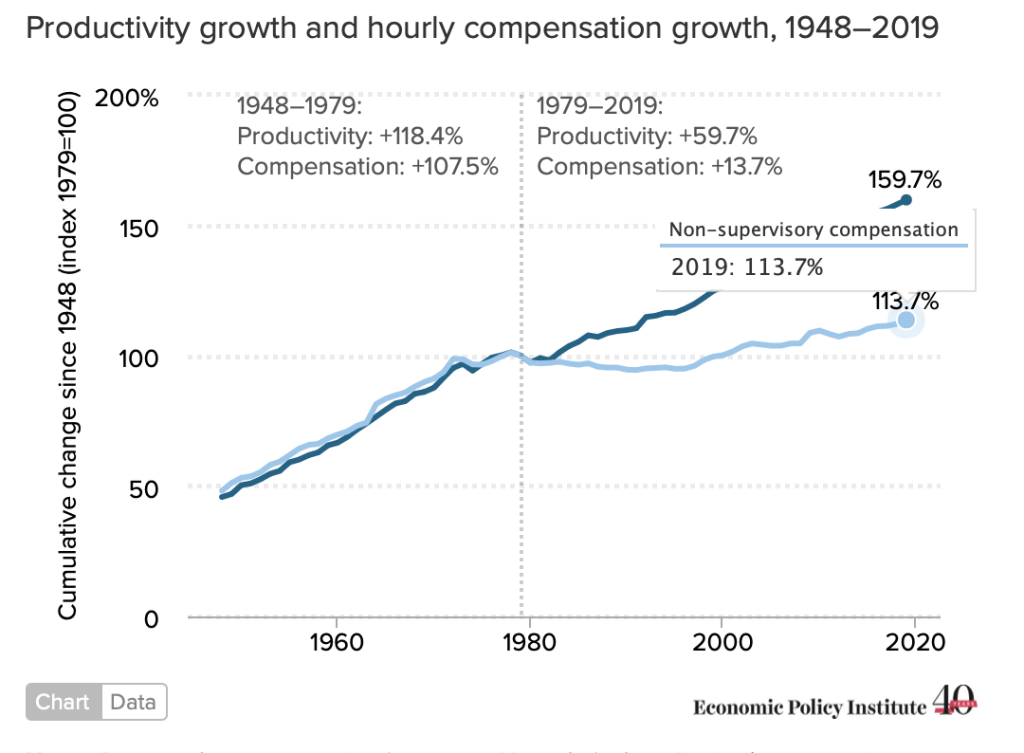
Meanwhile, as we’ve seen since the dawn of the Neoliberal age of the late 70s, productivity has become completely divorced from wage increases for workers, with the additional profits created by increased productivity being channeled straight to the top while wages stagnate:
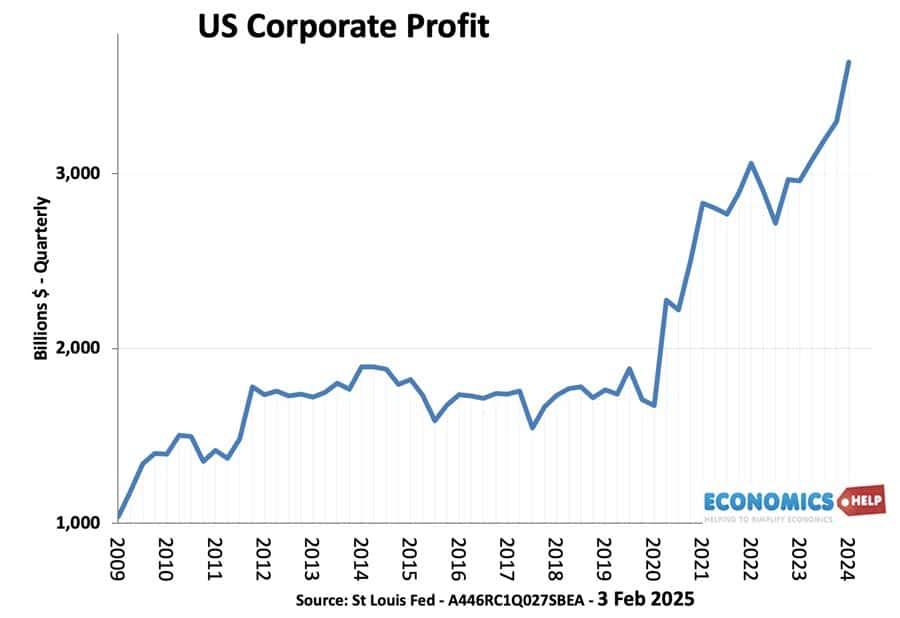
Corporate profits, meanwhile, have soared to previously unseen levels:
But since around 2003 increases in productivity also haven’t seen concurrent growth in employment as they have in the past, with employment rates instead faltering.
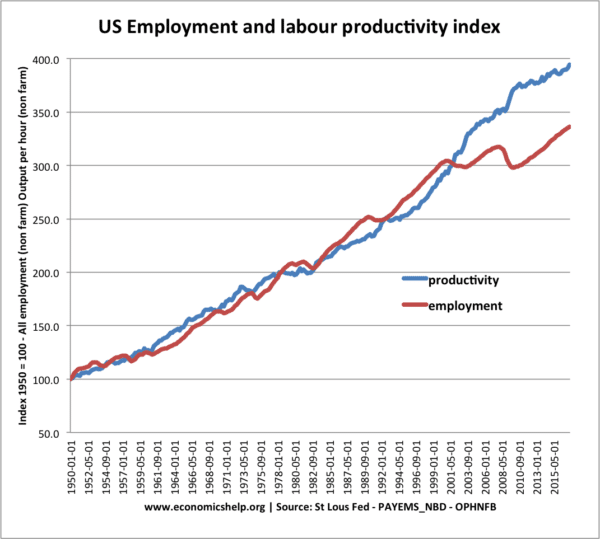
In other words, just because reductions in prices can potentially create greater economic activity that will offset job losses doesn’t mean it will, because the economy exists on more than one dimension, and if the money is captured by the top while the work becomes more precarious and lower paying, then lower prices don’t actually mean people have more money to spend. (And this is putting aside all the things about Baumol’s Cost Disease where certain types of commodities actually get more expensive rather than less, particularly housing, that I talked about in the episode about Infinite Growth.)
And of course this kind of wage hunter-and-gather style work typifies life under technofeudalism, everyone broken up into small units selling on Amazon, driving for Uber, making videos on YouTube, and so on. This is the world that the platforms want.
Part of the promise of AI is that it will replace labor. Sam Altman brags about how it will wipe out whole categories of jobs. And while these claims are probably overstated for publicity, I’ve talked about before how a lot of formerly skilled work is already becoming transformed into piecemeal labor training AIs. Following the waves of layoffs, tech employees in Silicon Valley are now obsessed with staying employed in order to avoid becoming part of the “permanent underclass”. Tech bros have historically talked about supporting Universal Basic Income as a solution to the unemployment created by AI, which might be a great thing if we could believe any of them actually mean it beyond it being good marketing for them. Open white nationalist Elon Musk, for example, will talk about how we need UBI on one day and the next day call Social Security “the biggest Ponzi scheme of all time”, when Social Security is just UBI for old people. As the economy grows more “K-shaped” it seems clear that the technological overclass sees little future for the rest of us and are more than happy to get behind a fascist program to discipline us into obedience and acceptance of the “new normal”.
Progressives like Robert Reich meanwhile just want to get back to the social democratic compromise of the New Deal era, thinking that the solution that didn’t stick before will surely work this time. I mean, if you could reinstate Keynesian economic principles, extremely high marginal tax rates like we had in the 50s, anti-trust enforcement, high levels of union membership, and so on, yes that certainly would make things better than they are now. But the capitalist class has spent the last 80 years or so doing everything to can to make sure that will never happen again. Money in politics has always been a problem, but in the years since the Citizens United ruling the corruption has gotten flagrant to the point where people don’t even seem to notice it anymore, a Teapot Dome-level scandal that in the past could bring down an administration popping up every other day. And let’s be clear, the Right wants the government as corrupt as possible, because it aids their narrative that governments can only ever be corrupt and should be reduced to stubs so that the free market can run wild. They corrupt the government to prove it’s corrupt just as they cripple government services to prove the government can’t do things. And, as economist Thomas Picketty laments, you’d not only need the US but at this point really the rest of the world to fall in line behind massive wealth redistribution in order to prevent the rich from simply moving all their money to tax havens.
And it’s easy to get blackpilled by all this. The Technofeudal order is designed to increase inequality, funneling ever more money to an ever smaller coterie of billionaires who control the platforms on which everything else operates. Endless war serves to help prop up the military-industrial complex and distract from crises at home by finding enemies to abroad. But don’t worry about mass inequality or ecological collapse or the fact that we’re committing war crimes on a near-constant basis, there’s some immigrants over there we can blame all your problems on and make you feel better by ruining their lives.
But everything about these monopolistic platforms guarantees their instability and enshittification as they cut corners rather than putting the work in to innovate, as they make ever more fragile supply chains, as they destroy the government funded research that actually creates the real innovation businesses build on, as their owners use their unfathomable wealth to systematically dismantle everything that once kept the system stable. And the increased precarity of labor on platforms mixed with rising costs of food and housing will make for an ever more desperate and radicalized population.
Things are going to get worse before they get better. In fact, I think we’re going to see world historic crises compound on one another, and its within the realm of possibility that there will be chaos, impoverishment, and death on levels we haven’t seen since the two World Wars.
But amid all of that it will be the networks of cooperative businesses, mutual aid, and so on, the lifehouses that offer ports in the storm, that will remain stable and that will only grow as more and more people are cast out of the capitalist-owned economy. Dual Power can only grow.
One primary goal, a key target to aim for, will be bringing the platforms themselves under democratic control, meaning companies like Amazon, Google, eBay, Facebook, Apple and so on.
The most obvious way, though not the only way, is through nationalization. The argument for this is simple and, in my view, undeniable: monopolies and rent-seeking undermine markets and anything that can’t be regulated by the market needs to be regulated by the people. Like roads and parks, these platforms should be owned and democratically managed by the public, by the people who actually use it. And unlike Standard Oil, you can’t simply “break up” a platform without it ceasing to be a platform. The Bork Doctrine might be brought against this argument but there’s a funny thing about the Bork Doctrine.
So the National Supermarket Association has brought an antitrust case to stop New York Mayor Zohran Mamdani from creating city-run grocery stores. They say that the city-run stores compete unfairly because by being subsidized by taxes they can offer lower prices. But, of course, as lawyers have pointed out, according to the Bork Doctrine, as long as the prices are low, what’s the problem exactly?
In fact, subsidizing prices with tax money is progressive, it allows the extreme wealth amassed at the top by people who have more than they can possibly spend to be used to subsidize cheaper food for everyone else. This is exactly what we should be doing with our society.
Of course, where creating cooperatives or community land trusts can go under the radar of capitalists, nationalizing Amazon definitely will not. We would have to build up substantial political and economic power in order to accomplish it, but it’s not impossible; breaking up Standard Oil or AT&T almost certainly seemed just as daunting before they were actually accomplished. The thing to bring to bear is that people—like everyone!—hates Amazon and Google and the rest of them. They just don’t have a solution to point to, and all the Right offers them is scapegoats, distraction, suffering, and the notion that systemic change is impossible.
But if large numbers of the sellers on Amazon are federated into cooperatives or otherwise organized, they can use that position to lobby for the government to do something about the ogre bearing down on their sales. Or—and this is another way of going about this if nationalization continues to be beyond the pale—they can use their position of economic power to make their own Amazon owned collectively by the sellers in the form of a producer cooperative. The thing that makes a platform monopoly a monopoly is its institutional presence and the fact that it already has a critical mass of both sellers and buyers in its system. But if coordinated together the sellers can simply take their critical mass and make their own system with it. Just as I talked about in the Cooperatives video about how YouTube creators can strike off at small scale on platforms like Nebula and Means TV while continuing to be on YouTube, sellers can make their own platform in parallel to Amazon. And as Amazon falters under the weight of its own drive to continually grow and enshittify, the cooperative platform will be there waiting to replace it.
What we’ve seen today is the triumph of the billionaires. But the systems they’ve created are brittle and unstable. The turmoil and battle for the political and economic systems instigated by that instability is already underway and we see it everywhere.
19th century socialist thinker Ferdinand Lasalle once wrote that the French Revolution, in which the bourgeois led the peasants in rising up against the aristocracy, was only possible because of the economic revolution that preceded it in which the bourgeois had grown wealthy and powerful on the back of land enclosure and wage labor. The actual overthrow of the aristocracy then was then just the “external recognition” of a transition of power that had already materially taken place. Even things like the Bolshevik Revolution came on the back of a loss of material power by the aristocracy and the growth of power of workers councils (or soviets) that had been building since the failed revolution of 1905. And as David Graeber pointed out, often revolutions that seemed to have failed actually succeed by changing the terms of the debate and the vision of what’s possible. The rise of Neoliberalism led to the conditions of the economic crash of 2008 and the subsequent bailout of the banks that caused it, and that led in turn to both the Occupy movement and Donald Trump and his destruction of Neoliberalism and its replacement with policies of economic nationalism. And beneath all of that, with the rise of platforms and Technofeudalism, we’re seeing radically new economic conditions. And those economic conditions create political realities, and those political realities are rewriting what’s possible every day.
It’s time to build dual power. Let’s do it together.
Thanks for watching, I think I’m going to do something completely different next episode don’t forget to subscribe to find out what that is. You can get early, ad free episodes, exclusive author’s notes, bonus content and more by supporting this channel at Patreon.com/ericrosenfield. And I’d like to thank all my Patrons who I know I can count on come the revolution. And I’d like to particularly thank my $10 Patrons, Nancy S. Rosen, Curtis Shea, K8, Peter Bostrom, Danny Tomicek, Tim Nolan, Mohammad Amer, AnnaLovesRiley, Steve Lewis, Chaos Gritty, Naajaw, Kevin, Jack, Lukas, Rose Vice, Aeris Apperly, Paul Truong, Jonnybyte, Dragos Ristache, Direleech, Ralph Lowenstein, Steven Wright, Justin Jakimiak, Victor, and Young Breezy.
Thank you!
Bibliography
Books
- Escape from Capitalism: An Intervention, Clara Mattei, 2026
- Why We’re Getting Poorer: An Insider’s Guide to the Economy, Cahal Moran, 2025
- After Occupy: Economic Democracy in the 21st Century, Tom Malleson
- “Reform and Revolution”, Andre Gorz, 1968
- Evolutionary Socialism aka Preconditions of Socialism, Eduard Bernstein, 1899
- The Shock Doctrine, Naomi Klein, 2007
- Technofeudalism: What Killed Capitalism, Yanis Varoufakis, 2024
- Lifehouse: Taking Care of Ourselves in a World on Fire, Adam Greenfield, 2024
- October: The Story of the Russian Revolution, China Mieville, 2017
- Socialism: Past and Future, Michael Harrington, 1989
- Saving Capitalism: For the Many not the Few, Robert Reich, 2016
- The Working Man’s Programme, Ferdinand Lasalle, 1862
Videos
- “We Need A Library Economy”, Andrewism, 2022
- How China wins by doing nothing
- Tech workers want to avoid becoming part of the “permanent underclass”
Articles
- Lenin on the Soviet Union and State Capitalism
- 93% of the stock market is owned by 10% of Americans, 50% of the stock market is owned by 1% of Americans
- Private Equity controls 15-20% of the US economy
- Uber’s pricing strategy
- Trusts complained of “ruinous competition” in the late 19th century
- Standard Oil’s monopoly
- Sellers used to put poisons in food before regulations
- Von Mises blamed unions for the depression
- Andrew Mellon wanted to fuck the economy
- The insanity of the Bork Doctrine
- Monopolization and Consolidation in America
- Peter Thiel says “competition is for losers”
- Warren Buffet and his monopolistic “moats”
- Bill Clinton destroyed the welfare state in America
- Henry Ford, John D. Rockefeller, and Torkild Rieber all loved fascism
- Company’s and union-busting
- DOGE and the death of research
- Government research provides actual innovations
- AI bubble is all anyone’s investing in
- AI not boosting productivity
- The financialization of everything
- The wealthy are the only group seeing material growth
- Insane criticisms of Mamdani
- Karl Marx and the British Factory Acts
- How the Tory’s destroyed the NHS
- Medicare Advantage is a scam
- Americans support Medicare for All
- US Socialist Party Platform, 1912
- Pelosi held a grudge against AOC
- The party worked actively against Bernie Sanders in 2016
- Sweden’s Meidner Plan and how it was undermined
- Sweden caught up to Neoliberalism in the 90s
- The Duma represented the propertied classes in the Russian Empire
- Seed Commons
- Institute for Community Economics
- Flatbush Tool Library
- Ridgewood Commons
- Woodbine
- How making “lifehouses” supports Dual Power
- Little Free Libraries
- Economist analysis of technological unemployment
- The Death of the PMC
- Tech layoffs were in part to discipline white collar tech workers
- Productivity has become divorced from wages
- Sam Altman brags about how it will wipe out whole categories of jobs
- Musk talks about UBI and then calls Social Security a “Ponzi scheme”
- The K-shaped economy
- The US committing war crimes in Iran
- The Bork Doctrine supports Mamdani’s city-run supermarket