
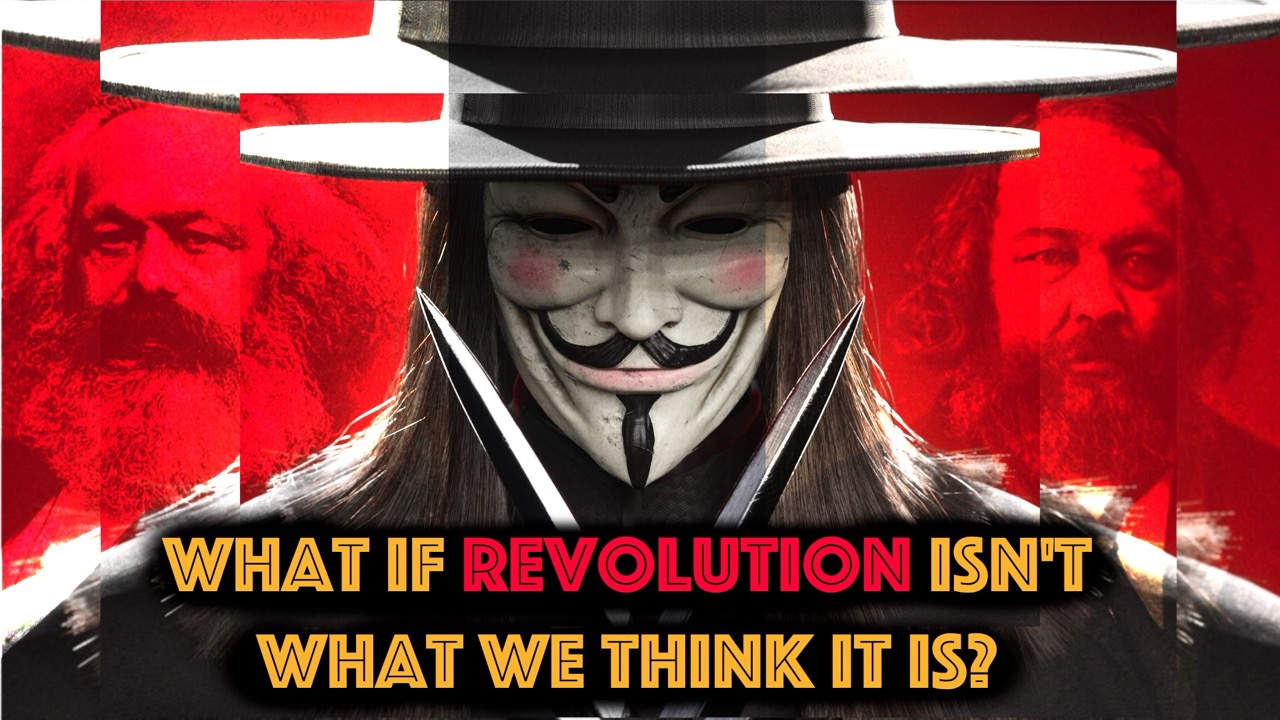
Following the blockbuster success of The Matrix trilogy of films (1999-2003), the writer-director Wachowski sisters could essentially do whatever they wanted. And what they chose to do, in the wake of 9/11 and the Bush administration’s ramping up of the surveillance state and endless war, was adapt a graphic novel in which a terrorist heroically bombs the institutions of a fascist government. This was, shall we say, a bold move, especially since the script makes explicit parallels between the film’s Norsefire government and the Bush administration. Indeed, there’s a sense that even with the caché of the Wachowskis at that moment, it was only because it was based on a successful graphic novel by a famous author and set in the UK rather than the US that the studio would allow it to be made at all. A similar film that opens with the hero blowing up the White House or the US Capital building as a strike against tyranny seems like it might have been a harder sell for a presumed blockbuster from a major studio. The fact we even got this is almost a miracle.
Of course, the parallels between Norsefire in the film and the Bush administration was one of the sore points for the graphic novel’s writer, Alan Moore, who felt the movie significantly defanged, softened, and oversimplified what he’d been trying to do in the book. Which is remarkable considering what I just said about the way the film valorizes terrorism. But comparing the two, one can see his point. The film presents the titular terrorist V as a charmer who even has a quasi-romantic relationship with his young charge/prisoner (who in the book is barely a teenager, but the film ages up to her 20s). In the book, meanwhile, V is far more unhinged, truly driven to madness by his ordeals. But fundamentally, in trying to reframe V for Vendetta in terms of a left-liberal struggle against fascism as a lens on the Bush jr. era, it strips the book of what it was about at its core: the larger political struggle of anarchism versus authoritarianism, of the social contradiction between the desires for both freedom and order. Where V of the book is openly an Anarchist and fundamentally sees his assault on the state as a step towards a leaderless future, the word “anarchy” is only mentioned once in the film as a reference to the insipid song “Anarchy in the UK” and is just used to refer to a state of chaos that has little to do with actual Anarchist philosophy.
Which helps emphasize how in common parlance there may be no political term more abused and misunderstood than Asnarchism. Well, maybe liberalism, but that’s another story altogether. I’ve referred to the different definitions of liberalism before, but I actually did a deeper dive on it that you can find on my Patreon which you can join for as little as $1 an episode at Patreon.com/ericrosenfield, where you can also get ad-free episodes, exclusive author’s notes, deleted material, extra goodies, music and more. And while I’m promoting things, don’t forget to like and subscribe.
{Chapter: Anarcho-Capitalism is not Anarchism}
Western education, at least in the US where I grew up and live, covers almost nothing of the history of Anarchism and Anarchist thought. Anarchism as a political philosophy does not refer to mere chaos and disorder, nor does it refer to some failed state riven to pieces by warlordism.
Nor, and I should get this out of the way, am I referring to “Anarcho-Capitalism”, which as I touched on in “Our Coming Cyberpunk Dictatorship” isn’t really anarchism at all. “Anarcho-Capitalism” looks at the problem of an ostensibly democratic government captured by corporate interests and decides that it’s the government that’s the problem. As if stripping away government protections but leaving corporations intact would allow unfettered competition to create a perfect society, rather than actually devolving into competitions over which corporation had the largest private army to dominate all the others and our lives with their undemocratic and essentially hierarchical corporate structures. In other words, it’s feudalism with extra steps, which is why it’s so popular with the sorts of billionaire oligarchs who want to create exactly this sort of “network state” feudal order in which they would rule without the pesky restrictions of petty things like democracy. It’s why the “libertarian to fascist pipeline” is a thing.
{Chapter: History of Anarchism}
No, if you understand anything about anarchism as a political movement, you have to understand that it’s fundamentally a form of socialism—a word here simply describing all leftist movements trying to create a more egalitarian society. Anarchism begins with the understanding that true freedom is incompatible with private property—by which we mean specifically the private ownership of enterprises and land, the ‘means of production’ that provide things like food and housing and everything else our society is built on.
While the idea of people sharing goods and property in common is so ancient that Jesus and his followers are said to have done it, the modern socialist tradition emerged as a reaction to the development of capitalism and the liberal ideologies it spawned. While the American Revolution was ostensibly premised on the notion that “all men are created equal” and the French Revolution on “liberty, equality, and fraternity”, as the 19th century wore on it became clear that this new system wasn’t delivering on its promises for the great mass of people. Instead, the noble lords and kings had been supplanted by wealthy barons who owned the businesses and land and forced workers from childhood to toil all hours of the day in dangerous conditions to churn out goods and services in order to produce their profits.
Soon various “isms” percolated through the culture, “communism”, “socialism”, “communalism”, “mutualism”, “collectivism”, “social democracy”, and so on, terms which at the time didn’t have precise definitions and were often used interchangeably. And while different philosophers and their movements proposed often radically different ideas, most of them advocated some form of commune- or worker-based control over the means of production to replace its private ownership by a lucky few at the top. French Philosopher Pierre-Joseph Proudhon (1809-1865) was the first person to use the term “anarchism”—from the Greek meaning “no leaders”—in the positive sense, and proposed that workplaces should be run by “democratically organized workers associations”.
Anarchism as a distinct movement of its own, however, emerged following the formation of the premier socialist organization of the time, the International Workingmen’s Association in 1864. This First International, as it was later known, became riven between two factions that would ultimately tear it apart: those who followed German economist and philosopher Karl Marx (1818-1883) and those who followed Russian revolutionary Mikhail Bakunin (1814-1876).
Marx and Bakunin both imagined a future society that was essentially stateless, with power devolved to independent committees and communally-run municipalities. (One of the ironies of Marx being associated with a totalitarian state in the popular imagination is that he thought the final form of communism would have no state at all beyond a minimal organization to help direct production, a “management of things and not people”, as his collaborator Friedrich Engels (1820-1895) would put it. Or, as Engels would put it elsewhere, “The society which organizes production anew on the basis of free and equal association of the producers will put the whole state machinery where it will then belong—into the museum of antiquities, next to the spinning wheel and the bronze axe.” This idea of all association being “free and equal” is key to all anarchist thought at well.)
Where Marx and Bakunin disagreed was in what’s known as the “transition problem”, which is to say how do we get from the current capitalist order to the future socialist one. Marx believed there would need to be a period following the revolution that he termed the “dictatorship of the proletariat”—but this didn’t mean dictatorship in the modern sense, but simply a period in which the workers would be in charge (Engels said that the “dictatorship of the proletariat” would take the form of parliamentary republic). But this “dictatorship” might still have to make what Marx referred to in The Communist Manifesto (1848) as “despotic inroads”, wielding state power to forcibly seize hold of property and eliminate class distinctions to create the conditions by which the state might finally be allowed to “wither away”.
(And if you’re thinking to yourself “socialism” is the interim period and “communism” is the final, stateless realization of Marx’s ideas, those are notions that come from Lenin, not Marx. Marx never used those terms that way.)
Bakunin, on the other hand, believed that giving any group of people power over others would transform it from a Dictatorship of the Proletariat to a Dictatorship over the Proletariat, because no group would consent to give up power and thus you’d just be exchanging one set of overlords for another. And indeed, it’s easy to argue, as Anarchists frequently do, that given the history of allegedly Marxist revolution this is exactly what happened. Indeed, Bakunin being Russian, said rather prophetically, “Take the most radical of revolutionaries and place him on the throne of all the Russias or give him dictatorial powers … and before the year is out he will be worse than the Czar himself.” Science and the Urgent Revolutionary Task (1870) (Anarchism theory and practice, pg. 46)
Instead, Bakunin imagined the process of the revolution itself would create the “free federation of agricultural and industrial associations” organized from the bottom-up (”from the base to the summit—from the circumference to the centre”) {Pg. 277}. By free association, they would then form the federated networks of communes that would make up the new organization of property and the means of production. {Demanding the impossible, page 275-280} Decisions within each commune would be made through direct democracy with universal suffrage for both genders.
Bakunin’s followers referred to Marx’s followers as “authoritarian communists” and themselves as “libertarian communists” (the term “libertarian” having Left Anarchist notions long before being seized upon and abused by the Right). Soon though these “libertarian communists” would simply be known as Anarchists, a word Bakunin himself also embraced. “We do not fear anarchy,” he wrote, “we invoke it. For we are convinced that anarchy, meaning the unrestricted manifestation of the liberated life of the people, must spring from liberty, equality, the new social order, and the force of the revolution itself against reaction.”
Unlike Marx among Communists, though, Bakunin is not usually considered one of the foremost or most coherent proponents of Anarchist thought. That honor generally rests with fellow Russian Pyotr Kropotkin (1842-1921), and his book The Conquest of Bread (1892) often called simply “the Bread book”) is the one that’s frequently thrust into people’s hands by Anarchists trying to help people understand. However, being a movement that prizes independence and freedom from authority above all things, Anarchism has understandably fragmented into many different hyphenated movements and schools of thought—Anarcho-Syndicalism, Anarcho-Communism, Anarcho-Collectivism, Anarcho-Primativism, Eco-Anarchism, and so on, leading to some Anarchists to refer to themselves as simply “Anarchists without Adjectives” as a pluralist tendency advocating cooperation and solidarity between Anarchist groups. (This factionalism inherent in a leaderless movement is also what lets things like Anarcho-Capitalism to not only pretend to be part of the same club but to often claim the mantle of anarchism for itself in the public imagination.)
Indeed, the term “anarchism” itself has become so loaded and misunderstood that many anarchists simply call themselves “libertarian socialists” or “libertarian communists” again, though these terms themselves are now caught up in their own nests of misunderstandings, where the term “libertarian” has been seized by right-wing arch-capitalists who see “communism” as its polar opposite of total control by the state. {Anarchism: From Theory to Practice pg.31}
However, it’s important to understand that Anarchism doesn’t actually mean “no organization”. Anarchism means “no leaders”, whether in the state, in the Church, or in the corporation. Anarchism is not without organization, indeed Anarchism can’t exist without organization, it’s just organization that’s decentralized, federated, horizontal, and based entirely on voluntary free association.
{Chapter: Anarchism Works}
For the purposes of this piece I’m not going to stray too far into discussions of what characterizes different anarchist modes of thought. Instead, I want to focus on something more general. When people who are not Anarchists talk about Anarchism there’s often this sense of its sheer naive impracticality, of how utopian, idealistic, and unworkable it all is. And it’s just not true. From small communes all over the world to large scale confederations like the Anarcho-Syndicalist organizations during the Spanish Civil War or the Makhnovshchina in Ukraine during the Russian Civil War, to more modern examples like the Zapatista controlled parts of Mexico or Kurdish Rojava in Syria, Anarchism, or things close enough to it to be indistinguishable from it, have worked just fine. But then, why shouldn’t it? Far from the Capitalist Realist claims that humans are essentially self-centered and greedy and so require competitive frameworks like market capitalism to be productive, in reality humans are naturally attuned to cooperate and work together. As I pointed out in Star Trek into Socialism, humans traditionally organized into far more egalitarian tribes, and early cities like Çatalhöyük which existed around 9,000 years ago in what’s now Turkey (and I’m making an effort to pronounce correctly because a Turkish viewer called out my terrible pronunciation last time) exhibited egalitarian social organization, indicated by the dwellings all being of more or less the same size. And in times of crisis, when we see people’s true nature under stress, rather than behaving in an every-man-for-himself fashion, people come together spontaneously, self-organizing to help one another. Anarchism is, in a word, natural, while unjust hierarchies are unnatural, imposed in order for some to maintain power over others and maintained by the explicit threat of violence. While each of these Anarchist situations had its own character and organizing principles, and while criticisms could be made of any of them much as any organizational structure has flaws, they all try or tried to operate with a minimum of hierarchy and a maximum of democracy and individual freedom. The point isn’t to create something perfect or utopian or frozen and unchanging, merely to create something better than what we have now. Indeed, calling Anarchism or Socialism “Utopian”—from the Greek meaning “no place”, as in a place that cannot and does not exist—is merely a way of dismissing the idea that fundamental structural change is possible. Likewise for the common truism that revolutionaries always become as bad as the people they overthrow, something which as with the examples above simply isn’t necessarily true either.
You might well ask, of course, if these things worked so well where are they now? Both the Ukrainian Makhnovshchina and the Spanish Anarcho-Syndicalists were destroyed by their supposed allies the Bolsheviks in horrific, violent betrayals committed while fighting right-wing forces, the authoritarian heirs of Marx living up to Bakunin’s dire warnings. Indeed, the Bolshevik Revolution had seen Pyotr Kropotkin himself returning to Russia from exile and American Anarchist Emma Goldman moving the new Soviet Union in hopes of helping to craft the egalitarian future of their dreams only to have those hopes crushed by reality. (Goldman would author the books My Disillusionment with Russia (1923) and My Further Disillusionment with Russia (1924) detailing what she had seen.)
Meanwhile, the Zapatistas in Mexico were attacked from day one of their declaration of independence in 1994 by the Mexican government with tanks and helicopters that bombed villages, which only let up following enormous protests in Mexico City. And so the government instead funded paramilitary groups to carry out attacks on the Zapatistas. Recently, the unchecked violence from the government and cartels has forced the disillusion of the Zapatista autonomous municipalities.
And in Syria, as of just last month, Rojava has been violently dismantled by the Turkish-backed Syrian Government which had previously agreed to work peacefully with it to reunite the region. Turkey has long sought the destruction of Rojava because it sees Kurdish Nationalism as a threat because of the large Kurdish population of Turkey that it’s long oppressed.
Anarchism then has not failed because its “unrealistic” or “impractical” or “unworkable”. It’s failed because the hierarchical societies outside of it don’t want it to succeed and are willing to enact terrible violence to ensure that it doesn’t. And this has been the story from well before Anarchism was a coherent ideology, at least as far back as the 15th century Taborites who decided to embrace communal living with “no more servants or masters,” where “all property would be held in common, and that there would be no more taxation.” For their troubles they were crushed utterly by the Catholic Church in what were known as the Hussite wars.
Indeed, Leninists will point to this and say that the reason Leninism is the only viable response to capitalism is because it’s the only one that can be said to have succeeded against it. When the Soviet Union was declared, four countries declared war on it immediately, including the United States. Much the same way as when the French Revolution happened, the revolutionaries weren’t only in jeopardy because of the terror engaged by their own leaders, but that terror was fueled in part by the fact that most of the rest of Europe had just declared war on them for having the temerity to overthrow their king, a man most of Europe’s rulers at the time was related to. And that constant warfare and chaos created the environment in which a strong man military leader like Napoleon could make himself the new Emperor. Communist China likewise emerged out of a century of constant warfare in which the ability to martial military power and unquestioned loyalty helped ensure military success. Per sociologist Charles Tilly who compared state formation to organized crime, the ability of a nascent state to continue existing depends less on its ability to deliver liberty and happiness to its people than on its sheer ability to enact violence.
{Chapter: Democratic Socialism}
In How Will Capitalism End?, I talked about how Democratic Socialism split from Orthodox Marxism in the person of Eduard Bernstein (1850-1932), who had known Marx and been a close friend and disciple of Friedrich Engels before he’d become a Marxist apostate. Essentially, Bernstein had taken issue with two claims from Marx’s Capital: Volume 1(1867): that the number of the bourgeoisie—the owners of businesses and land—would decrease as wealth devolved into fewer and wealthier hands, and that the wages of the proletariat—the workers—would decrease as the business owners monopolized industries and tried to maximize their profits by minimizing labor costs. In short, the rich would continue to get rich while the poor got poorer. Marx had concluded that this progressive immiseration of the masses would be the catalyst that would lead them to rise up against their masters and seize the means of production in revolutionary activity that would spread, as capitalism had, around the world.
However, Bernstein’s research into the four most developed capitalist countries of the 1880s and 90s—Germany, France, the UK, and the United States—showed that at least at the time this wasn’t happening. Instead, the numbers of the bourgeois were increasing and wages were going up. Further, at the time Bernstein saw that popular agitation, organization, and suffrage had secured more benefits to workers than had any violent revolutionaries, who at the time had primarily inspired reactionary backlash. Thus, Bernstein had become a proponent of gradual and peaceful democratic reforms rather than violent revolution as a means of combating the iniquities of capitalism. This, as you might imagine, was not a popular stance among the Marxists, with prominent figures like his formerly close friend Karl Kautsky and Rosa Luxemburg writing pamphlets against him. Capitalism might have shown itself to be more adaptable than previously thought, but the fundamental contradictions remained. A system based on a small number of people at the top controlling everything while the wage workers beneath them did all the actual work could not last, especially as productivity increased with the rise of automation.
And, of course, one can point out the irony that while the government of the Weimar Republic, of which Bernstein was a part, did indeed create many worker-friendly reforms, it also preserved many of the structural problems of the empire it replaced and worked to crush the Marxist Left that wanted greater change and thus helped pave the way for the Fascist dictatorship (bankrolled by the wealthy) that would work to roll back everything it had achieved just after Bernstein himself passed away.
Still, the postwar world saw the dominance of the kind of social democratic reforms Bernstein had championed and with it a period of prosperity in the developed West in the middle of the 20th century. However, capitalists spent that period conspiring their comeback and seized on the economic downturn of the oil shock of the 1970s to make their move and introduce a program of Neoliberalism that would roll back regulations, taxes on the wealthy, and public benefits, destroy unions and other forms of worker power, and end the fundamental correlation between increased productivity and increased wages.
If we try to measure the current economic state using the terms Bernstein used, we run into some problems. The number of business owners have indeed increased year-on-year, therefore technically growing the ranks of the bourgeoisie, but a closer look at the statistics tells an interesting story. 81.9% of small businesses are “nonemployer firms”, meaning they have no employees, only an owner. And this corresponds to the trend of people being forced to classify themselves as independent contractors rather than employees (with concurrent benefits and tax advantages) and people being pushed out of the labor force and desperately trying to put a living together selling things on Etsy, performing sex acts on OnlyFans, driving for Uber, delivering for Doordash, making YouTube videos, and so on. And the percentage of small businesses that are nonemployer firms has been steadily growing. Meanwhile, today’s top 1% of companies by sales account for 80% of revenues, compared to 60% in 1969 as corporations at the top continue to consolidate into fewer and fewer major firms. But perhaps the greatest indicator of the concentration of the ownership of the means of production into ever fewer hands is the fact that today 93% of the stock market is owned by 10% of Americans, while the bottom 50% of Americans own a bare 1% of stocks, percentages that have only grown worse over time. Meanwhile the percentage of corporate equity that’s come out of the public markets and into the even smaller number of hands that control private equity firms has grown from 4% to 20% between 2000 and 2023.
As for wages, while they have increased, lately they’ve had trouble keeping up with inflation, and as mentioned they have not nearly kept up with increases in productivity, with the additional profits created by that productivity going straight to the top 1%, who’ve seen their share of wealth skyrocket. The result has been a sliding middle class, with Pew research showing a consistent trend of the middle class shrinking and the lower class growing, losing nearly a fifth of its share of national income over five decades. But more than that, the increased cost of housing means that now nearly half of all American renters spend more than 30% of their income on housing with that number rising particularly radically among low-and-middle income renters, with over 70% of homeowners and 80% of renters with incomes below $30k spending more than 30% of their income on housing, and over 70% of renters earning between $30k and $45k a year, numbers that have been steadily rising for years. But of course the cost of housing is going to outpace rises in wages in a system where a basic necessity like housing is seen as an investment vehicle, it wouldn’t be considered a “good investment” if it didn’t. Meanwhile, despite some successes in the 2010s through housing-first policies, homelessness is once again skyrocketing.
But it gets worse. In terms of the economy, people who aren’t rich are ceasing to matter. Today the top 10% of Americans by income account for nearly half of consumer spending, while the bottom 60% by income account for a bare 10% of consumer spending. Corporate spending on AI is now greater than all spending on personal consumption put together. Three people have as much wealth as 50% of the planet. And skyrocketing costs of assets from stocks to real estate to gold make it ever harder to join the bourgeoisie by buying their way into passive income while inflating the fortunes of those who already have significant holdings.
Pile onto this the reduction of skilled labor into deskilled AI training (or outright AI impersonation) that I discussed in “How Capitalism Becomes Feudalism” and the massive job losses already piling up and only predicted to increase. Not to mention the threat of an AI financial bubble collapse and the ongoing global ecological crisis, and we have a heady mix of indicators that things are not going to get better soon.
In the past, I’ve said what we need to do to combat this is build up worker power in extra-governmental organizations, like unions, cooperatives, and political organizations like the Democratic Socialists of America. And I finished “Our Coming Cyberpunk Dictatorship” by positing a scenario in which an actual left-leaning Democrat manages to get into office following the Orange Fuhrer and uses the ways in which he’s expanded the office to make real, substantive change. And I still think all that is the best we can hope for in the near future.
But at this moment, in 2026, it sure looks like Luxemburg’s been vindicated, doesn’t it? And that we’re right back on Marx’s train towards mass immiseration and everything that goes with it.
I talked about the technofeudalist end goal in “Our Coming Cyberpunk Dictatorship”, and while billionaires salivate over transforming Greenland into a Network State dystopia, I think the real clue to where they see this all going is in the outskirts of Salt Lake City, Utah. While “housing first” policies have been shown to be by far the best solution to homelessness, because it’s sure hard to do things like secure a job if you don’t have a safe place to sleep at night, Trump seems to have a different strategy for dealing with homelessness. His plan is to involuntarily commit homeless people to a camp where they will have “work-conditioned housing”. Of course, there’s another word you could call “work-conditioned involuntary housing”. Slavery. Indeed, this sort of thing has a precedent in this country, since the Constitution actually explicitly allows slavery as punishment for a crime, after the Civil War southern whites went to great lengths to invent pretexts to reimprison black people on trumped up charges, creating prisoners they would then “lend out” to plantations as a roundabout way of reimplementing slavery. Indeed, forced labor in prison was one of the things that was conspicuously absent from, “Our Coming Cyberpunk Dictatorship”, though I mentioned it in my Author’s Notes on Patreon, which you can find at Patreon.com/ericrosenfield and join for as little as $1 an episode. The reason was simply because I didn’t want to go into too much of a digression of how today prison labor leased out to private companies is actually a very small percentage of prison labor (about 3%) (which admittedly is still horrific), with most prison labor going into government work or providing free labor to help run the prison itself. (Also 8% percent of prisoners are in private prisons, while 90% of ICE detainees are in private detention centers, directly making profits for shareholders by virtue of their imprisonment.) But with the homeless camps we’re seeing this expanding out to people who’s only crime is having nowhere to live, criminalizing poverty (even more than our criminal justice system already criminalizes poverty). As with the imported “menial laborers” Fascist thinker Curtis Yarvin imagined in his demented Network State manifesto, a la Dubai where opulence built on slave labor is the order of the day, we can see where this heads and what this means.
However, as I also said in “Our Coming Cyberpunk Dictatorship”, these billionaires are also morons surrounded by sycophantic yes-men constantly proclaiming their genius. The likelihood that any of this Network State bullshit can succeed I think is pretty small, but the likelihood it destroys the political stability folks in the West have essentially taken for granted since the end of World War II seems to already be taking place.
In fact, the billionaires seem to tacitly understand the probability of collapse but instead of trying to work to make the world better for the mass of people, they build bunkers and wonder about how they’ll control their security guards once the world is burning and money no longer has any meaning.
The reason I’m a proponent of Democratic Socialism is because Democratic Socialism is the best case scenario. I would like for us to peacefully move towards a more egalitarian future. Why wouldn’t I? But as with Anarchism, the problem isn’t so much that one cannot democratically make reforms to redistribute wealth per se, but that those with wealth and power will fight such reforms as an existential threat and because they have wealth and power they’ll be able to do a lot of damage. That they won’t understand that submitting to reforms that redistribute power will not only make society better for everyone, but that it’s the only way to avoid the kind of cascade of political and social collapses that not only results in the destruction of their carefully hoarded wealth but potentially also finds them in the warm embrace of the guillotine.
New York Mayor Zohran Mamdani proposes something as anodyne as the City government opening up some grocery stores in food deserts, and the rich of the City behave like we’ll be hunting them for sport. Zohran may have won his election, but even now Donald Trump is testing the waters for how far he can suborn elections, the the loathsome Larry Ellison is amassing even greater control over multinational media to, like Rupert Murdoch before him, sheer off all semblance of anything that isn’t explicitly defending the primacy of existing wealth and power, and the ostensible opposition Democratic Party is pitching new ways of positioning themselves without upsetting their billionaire backers.
As mentioned, V for Vendetta opens with acts of terrorism against a government framed in heroic terms. Anarchism, of course, has a long association with terrorism. In the late 19th century, the “bomb throwing Anarchist” became a cliché as anarchists bombed locations all over Europe, from the French National Assembly to a Spanish theater orchestra pit. Anarchists also assassinated a string of world leaders including the President of France, the Prime Minister of Spain, the Empress of Austria-Hungry, the King of Italy, and President William McKinley of the United States. This was what was known at the time as “Propaganda of the Deed”, actions designed to show the vulnerability of bourgeois society and inspire workers to rise up in revolt. However, for the most part Propaganda of the Deed mostly just inspired reactionary backlash and moral panics. And the workers were far from always on board with this violence. Emma Goldman’s husband, Alexander Berkman, attempted the murder of industrialist Henry Clay Frick during a steelworker strike that Frick had attempted to violently put down with both private goons and the National Militia. Berkman ended up subdued by the same workers he was trying to kill in the name of. Ultimately, Propaganda of the Deed was left behind by the Anarchist movement as a strategy that had failed. V for Vendetta wants us to imagine a lone figure striking fear in the state will inspire the populace to rise up spontaneously against it, but in reality this simply isn’t how revolutions happen.
But revolutions also don’t happen, as some leftists seem to think, just because the working people become more and more miserable and poor. Sometimes you’ll see leftists say things like “wealth inequality now is as bad as it was in Tsarist Russia before the revolution”, as if wealth inequality was the only reason the Russian Revolution occurred, as if Russia and most other countries hadn’t had extreme wealth inequality for as long as they’d existed.
Autocrats maintain power by a shoring up support among key elites including the military, and while the people may protest and demand change, if the military does not cross over to their side, usually what we see are things like the successive crack downs of Iran before the beginning of the recent war.
To quote Revolutions: A Very Short Introduction (2013) by Jack A. Goldstone, “Revolutions can occur only when significant portions of the elites, and especially the military, defect or stand aside. Indeed, in most revolutions it is the elites who mobilize the population to help them overthrow the regime.” Or, as Vladimir Lenin once put it, “For a revolution to take place, it is usually insufficient for ‘the lower classes not to want’ to live in the old way; it is also necessary that ‘the upper classes should be unable’ to live in the old way”.
The thing is, what we have in America isn’t just an immiserated and immiserating populace. What we have is a formerly comfortable middle class sliding back into immersation through a series of decidedly K-shaped economic crises. A middle class that has steadily papered over its loss of relative income with debt in the form of credit cards, home equity credit lines, second mortgages, reverse mortgages, payday lenders, and an influx of buy now/pay later services.
It’s been widely commented on that the population behind the January 6th insurrection were not the working poor they’re sometimes portrayed as but the relative middle, including petty bourgeois small business owners and white collar professionals who’ve seen their quality-of-life progressively degraded by the soaring costs of basics like housing, transportation, and food, and mounting piles of debt. Nearly 60% of the rioters had filed for bankruptcy at some point. And while they were essentially revolting in the name of a fascist who was actually trying to accelerate all of their problems, their base has already begun to turn in the face of broken promises, evidence of rampant child abuse, worsening economic conditions, and endless war. Meanwhile, these same qualities are the things that have fueled the turn of the young Professional Managerial types who historically have represented the vanguard of the Democratic Party farther left to Democratic Socialists like Alexandria Ocasio-Cortez and Zohran Mamdani.
Meanwhile, as the US continues to sink into an unending chain of unwarranted military boondoggles in Asia that are more wildly unpopular than ever, Trump’s deployment of the National Guard to US cities amid his ongoing horrific ICE kidnappings caused National Guard morale to plummet and enlistment to decline. One wonders whether such soldiers would be willing to oppose any kind of popular uprising of their fellow Americans given further social and economic collapse.
This doesn’t mean that I think a revolution is nigh. But the most recent incident of something that might be called ‘Propaganda by the Deed’ is illustrative. Luigi Mangione is not an Anarchist and his ideology seems to be a more common and less well-defined loss of faith in American institutions across the board. And his murder of UnitedHealthcare CEO Brian Thompson is unlikely to directly result in revolution or even copy-cat murders at this stage of the game, despite oligarch fears to the contrary. But while the rich and their creatures have made a show of how aghast they are by the murder, the rank-and-file of both left and right have openly celebrated the death of someone whose business is responsible for so much completely avoidable human misery and death.
No, revolution probably isn’t nigh, but the conditions rendering the US unstable and vulnerable to internal violence are not getting better and as they get worse, if Marx’s predictions finally play out, then it’s hard to see how we don’t arrive there eventually. Further, things can change very quickly and revolution can be difficult to predict. Vladimir Lenin also said “We of the older generation may not live to see the decisive battles of this coming revolution” a month before the Russian Revolution began that would ultimately bring him to power. A status quo can continue for a long time before sudden and explosive changes. And if nothing is done to arrest the processes currently boiling beneath the skin of the country and the world, we’ll continue sliding into a revolutionary situation.
And the thing about violence is that for everyone there’s a line beyond which political violence against the state justified. The American revolutionaries taking up arms against the British authorities was an insurrection against the state that Americans today generally believe was justified—as the US Declaration of Independence states “when a long train of abuses and usurpations, pursuing invariably the same Object evinces a design to reduce them under absolute Despotism, it is their right, it is their duty, to throw off such Government”. Indeed, Thomas Jefferson, who chiefly wrote that Declaration, is also famous for saying, “The tree of liberty must be refreshed from time to time with the blood of patriots and tyrants.” Or, as V puts it in the film, “Violence can be used for good.”
Likewise, no one except perhaps Nazis object to, say, the Warsaw Ghetto Uprising during World War II, in which Jews slowly being starved to death by Nazi authorities rose up in arms against them and were massacred. The state, of course, will inevitably disavow any and all violence against it—after all, the whole point of the state is to have a monopoly on the use of force.
In America, at least, most of the action in forming militias and planning for a coming insurrection has happened on the Right, something that seems to have been tacitly allowed by the folks in power in a way it never would have been if those same militias were made up of left-wing anarchists or communists. There are though left-wing militants who will tell you what we really need to be doing is buying guns and practicing guerrilla warfare techniques. And that’s not exactly the kind of thing I’m gonna get behind, and not only because I’m old, out-of-shape, emotionally fragile, and would probably be one of the first up against the wall in the event of Civil War 2: Electric Boogaloo. But fundamentally I don’t think the way we win is with guns and bombs. The way we win is when they put down their guns and bombs and join us because continuing with the status quo is untenable. And as fascists work to undermine elections, the concentration camps and work camps are erected, bombs fall on children, and we become serfs to the pedocrats at the helm of state, well, it seems like the status quo for most people is getting more and more untenable every day.
Alan Moore himself actually repudiated violence by the time he was finishing V for Vendetta. In a sense this is why V has to die at in the end. V is a killer, a destroyer of things, not someone who builds things anew. As Evey says in the book after V has died, “The age of killers is no more. They have no place within our better world.” {Issue 10, pg. 26} In an interview years later, Moore talked about violence, saying that in book 3 of V for Vendetta, violence is rejected, that “killing people is always wrong; and at that point the initial hero V stands down and lets a non-violent person take over the role.”
Indeed, in both the comic and the film, Evey is captured and treated to the torture and torment of life in a concentration camp, only for it to be revealed that it was V who’d captured her all along and done these things in an effort to “free” her from the prison of her life, because that was what had happened to him and how his mind had been freed. V makes her like him.
Now, this is very dramatic way to show V’s backstory, but it’s also you know, a pretty messed up thing to do to someone. Torturing people “for their own good” is not a great look, and in the book even more than the film, V is pretty obviously a psychopath, someone essentially driven mad by the horrors done to him by the regime. This perhaps gets into a problem Moore would stumble on again with the character Rorshach in his book Watchmen (1986-1987), which is when a character who’s meant to be cautionary becomes seized upon as aspirational because he’s just cool. Of course, unlike V, Rorshach was never supposed to be cool, he was supposed to be the kind of mentally ill, antisocial weirdo that these sorts of violent vigilantes would be in real life. But when you have somebody in prison say, “None of you understand. I’m not locked up in here with you, you’re locked up in here with me,” well, people are gonna like that sort of thing. Meanwhile, a poetry quoting, knife-wielding, always-one-step-ahead-of-the-authorities kind of guy like V seems purpose-built to be a hero of the people. And really, he was. Alan Moore is a self-described anarchist, after all, and originally “intended it to be a pretty trite piece of propaganda. But it didn’t work like that – it came out superficial and hollow.” And so his comic about the battle between liberty and authority, between anarchy and fascism, became a much more nuanced piece that both explored the psychology of the fascists in humanizing depth, and framed its hero protagonist as fundamentally terrifying and insane, to be rejected and moved on from. And this is something that’s mostly lost in the movie, which positions V and Evey in romantic, Hollywood terms, V as a heroic figure despite the whole kidnap and torture thing, and his opponents in the Norsefire government as two dimensional sadists.
Indeed, it’s worth noting as El Sandifer does in her magisterial Last War in Albion, that V for Vendetta began as one of Moore’s earliest works, on which work was paused when the magazine serializing it went out of business, only for it to be brought back and completed years later when Moore had considerably more clout. In between those two points, Moore had gone deep into superhero fiction with, among other things, his runs on Captain Britain, Marvelman (known in America as Miracleman), and, of course, Watchmen. As Sandifer puts it about the last part of V for Vendetta, “Moore was writing this coming off of a lengthy exploration of the aesthetic endpoints of superhero narratives that found fascism sitting coldly at every terminus.” Moore had, after all, said as early as 1983 of Superheroes that “there is a lot of fascism in the idea. Somebody said the difference between Superman and a mass murderer is in fact very little—they’re both people who assume they have the power and assume they have the right to inflict their own conception of justice on the world. There is a lot of really strange morals there which are really interesting to explore.”
In my episode “Superman and the Case for Open Borders”, I talked about how the Superhero genre is specifically maladapted to address problems that require systemic solutions, and indeed have a tendency to become right wing narratives, because superheroes are inherently special, with “powers and abilities far beyond those of mortal men”. And so it’s easy, as Zack Snyder for example is wont to, to portray them as people “for whom rules don’t necessarily apply and of whom ordinary folks merely jealous, easily fooled, and liable to get in the way or hold them back. In other words, they feed into an idea of natural hierarchies and black-and-white worldviews where there are good people who must be defended and bad people whose lives are expendable.” Watchmen, after all, is in the end about a man portrayed as the paragon of human physical and mental achievement—a blond-haired, blue-eyed Übermench—who amasses enormous wealth and power with which he decides to unilaterally inflict mass death and suffering in the name of the Greater Good. The nearly omnipotent Dr. Manhattan, meanwhile, decides to abandon this galaxy for “one less complicated”, and suggests he might create some humans of his own, assumably less complicated and more perfect ones. As with Rorshach, that these figures were not meant to be aspirational is exactly the kind of thing lost by fans like Zack Snyder who sought to make a rigorously faithful adaptation of the work that at the same time removed all the careful irony and subtext and replaced it with a sensibility of making the characters look as awesome as possible at all times. But of course the man who made the beautiful fascist apologia 300 would not understand that the fascist overtones of Alan Moore’s work were not supposed to be wish fulfillment. (And it’s also ironic that Zack Snyder is very much someone who doesn’t understand that the themes of his work are fascist, and if you told him they were he’d probably think you were crazy.)
The Wachowskis don’t fall quite so easily into this trap; in fact one of the core themes of the Matrix Trilogy is the way in which lifting someone up as special and the “one” who will save us all is actually a set-up by the powers that be to re-entrench their own power and maintain the status quo. But with V for Vendetta they end up frequently letting their fury over the banal evil of the Bush administration allow them to lionize special individuals for their ability to deal out violence against enemies. And yet, for all its flaws, in some ways the ending V for Vendetta the film improves on the book. Instead of V dying and passing on his mantle to another individual who will represent the new era, V sends masks out to everyone, so all of us together become the new figures who will lead the world into the future. Despite the film excising all explicit mention of Anarchism as a coherent political movement, this ending is more anarchist, no clear leaders necessary. Likewise, the film’s ending is more hopeful about the future, while the book is much more ambivalent. In the book, “This country is not saved… do not think that… but all its old beliefs have come to rubble and from rubble may we build… That is their task: to rule themselves; their lives and loves and land… with this achieved, then let them talk of salvation. Without it, they are surely carrion.”
In 2008, Anonymous, less of a group than an idea of a movement that began life on the infamous 4Chan messaging board, turned to activism with a campaign against Scientology. Protestors soon showed up at Scientology sites around the world, and because of the religion’s notorious litigiousness, they took to wearing masks. The cheap plastic Guy Fawkes masks produced by Warner Bros in promotion for the film were a natural fit. Moore, for his part, was delighted, saying the demonstrators in masks gave him “a warm little glow”.
In 2011, in the wake of the 2008 financial crisis and the following bailout and a perceived lack of material change in the economic conditions that had produced the crisis, the anticapitalist group Adbusters proposed a “Million Man March on Wall Street”. Anonymous endorsed the demonstration, and many of the protesters showed up donning the mask. As the protest transformed into an encampment that became known as Occupy Wall Street, the protesters created what could be seen as an alternative vision of society, an overtly Anarchist community with its own food services, library, and ad hoc governance. Hundreds of Occupy encampments began to spring up around the world.
No one was more ecstatic about this turn of events than Alan Moore, who said “if something I wrote 30 years ago can be of some use then I take great pleasure in that.” One of the common criticisms of the Occupy movement was that they had no coherent demands, to which Moore, after visiting the Occupy London encampment, remarked, “I don’t think that it’s necessary to have plans to change the world. They are protesting the way that the world is going, and I would say that having spoken to these people, they are at least making a decent fist of actually trying to come up with alternative ways of organising societies, whether that’s the small society of people in tents here, or society in the broader sense.”
Author David Graeber, one of the more well known anarchist intellectuals of recent years, was heavily involved with the Occupy movement and became something of its spokesperson, sometimes being dubbed its “anti-leader” by the media, and coined the phase “We Are the 99%”. He described the encampments themselves as a form of direct action to which demands would be a detriment, because making demands of the existing authorities recognizes the legitimacy of their authority. Instead, the encampments bow out of that authority structure entirely. “Direct action,” he said, “is a matter of acting as if you were already free.” He said further, “Essentially, the strategy is to create alternative institutions, based on horizontal principles, that have nothing to do with the government, and declare the entire political system to be absolutely corrupt, idiotic, and irrelevant to people’s actual lives, a clown show that fails even as a form of entertainment, and try to render politicians a pariah class.” He called this the Buenos Aires strategy or the Argentina model after the wave of self-organized assemblies and occupations in that country after the 2001 economic crisis.
Graeber posited that an anarchist revolution wouldn’t look like battles in the street. How could it? “It’s not like a bunch of anarchists are going to military [sic] defeat the 101st Airborne Division. […] The only plausible scenario for revolution is when it comes to the point that the forces of order refuse to shoot. For most revolutions in world history that is what ultimately happens.” He called it an “eggshell theory of revolution”. “You just hollow it out until there’s nothing left and eventually it’ll collapse.”
As I’ve discussed, Marxists have long argued that the first thing the revolutionaries need to do is to seize state power for themselves. Per Graeber, instead the traditional Anarchist call has been to “begin ‘building the new society in the shell of the old’ with egalitarian experiments ranging from free schools to radical labour unions to rural communes.”
What’s interesting is that in his book about Occupy Wall Street, The Democracy Project: A History, A Crisis, A Movement, Graeber offers a counterintuitive idea of what revolution actually consists of and means. Drawing on the work of historian Immanuel Wallerstein, Graeber talks about how there’s often globally connected revolutionary periods that, even if the literal revolution fails, can fundamentally change basic assumptions about what politics are about and the scope of what’s possible. Though the French Revolution was ultimately undone, by a generation later ideas that it espoused of government deriving authority from the people became common currency. The Revolutions of 1848, which broke out almost simultaneously in fifty countries and became the impetus for the writing of Marx and Engles’ Communist Manifesto, resulted in almost no revolutionaries actually taking power. However, it created the conditions in which things like universal systems of primary education were created nearly everywhere (and of course, The Manifesto would have repercussions for generations). The Russian Revolution of 1917 helped pave the way for the Social Democratic Compromise period of Keynesianism and Welfare States that dominated the West in the mid-20th century. Meanwhile the revolutions of 1968 that broke out everywhere from France, to China, to Mexico, “seized power nowhere but changed everything”. Modern feminism emerged out of these movements, as well as the idea of the inseperability of personal and political liberation (”the personal is political” as it were) and a backlash against institutions and bureaucracy.
In the United States, following the mass protests of the Vietnam era, the US refused to commit US ground forces to a major conflict for almost thirty years and effectively ended the military draft during wartime. When large scale military engagement resumed following 9/11, it was accompanied by incessant propaganda and “experts provided exact calculations on body bag count (how many U.S. casualties it would take to stir mass opposition), and the rules of engagement were carefully written to keep the count below that.”
The results were tactics relying on heavy bombing that minimized death and injuries to Americans at the expense of thousands or even hundreds of thousands of Iraqi and Afghan civilians, which fostered an intense hatred of the US that fatally undermined the war effort. As Graeber puts it, “It’s as if American forces in Iraq were ultimately defeated by the ghost of Abbie Hoffman.” There’s a sequel I could do to my episode “How the Hippies Became Yuppies” where I could deep dive into this sort of thing and the relationship between the hippies and Silicon Valley discussed for example in the book From Counterculture to Cyberculture: Stewart Brand, the Whole Earth Network, and the Rise of Digital Utopianism by Fred Turner.
Indeed, as Graeber points out, the main beneficiaries of the late 60s “prioritizing of individual liberty, imagination, and desire, a hatred of bureaucracy, and suspicions over the role of government” has been the political Right.
Graeber, though, also points out that the Neoliberal Project that succeeded the Vietnam period has actually been wildly ineffective at its supposed goal of improving the economy. Global economic performance over the last forty years has been mediocre compared to the Keynesian period before it, with the notable exception of places like China that took a much more state-managed approach to economic development.
However, the Neoliberals have done an excellent job of convincing the world that financialized, semi-feudal capitalism is the only viable economic system. What we’ve gotten in this period is a massive security and intelligence apparatuses, and the kind of media environment where half of all dramas on broadcast television celebrate the police. Per Graeber, “Eliminating guaranteed life employment for precarious contracts doesn’t really create a more effective workforce, but it is extraordinarily effective in destroying unions and otherwise depoliticizing labor. The same can be said of endlessly increasing working hours. No one has much time for political activity if they’re working sixty-hour weeks. It does often seem that, whenever there is a choice between one option that makes capitalism seem the only possible economic system, and another that would actually make capitalism a more viable economic system, neoliberalism means always choosing the former. … Yet as a result of putting virtually all their efforts in the political basket, we are left in the bizarre situation of watching the capitalist system crumbling before our very eyes, at just the moment everyone had finally concluded no other system would be possible.”
Arguably, there was another inflection point around 2011 in the wake of the 2008 financial crisis, which not only saw the hundreds of Occupy encampments, but the Arab Spring revolts across the Islamic World and protests in India, Chile, Greece, Spain, and China. Much as the with the revolutions of 1848, most of these movements can be said to have ultimately failed in their immediate objectives. But they were part of another global sea change in the imagination of the possible in the face of the Neoliberal Order. And as in ‘68, thus far the main beneficiaries have been the right, with a global resurgence in authoritarian regimes and persecution of minorities, especially immigrants, as norms of free trade and international cooperation have broken down. (Though as mentioned there has also been a concurrent resurgence of interest in socialism particularly given the failures of center-left technocrats to adequately cope with the right-wing rewriting the rules of the game.)
That all said, the oncoming Techno-Feudalist order the Right Wing Billionaires and their authoritarian creatures are creating is merely a natural endpoint of the fundamental contradictions of capitalism. Capitalism is a system that simultaneously requires competition to be stable but relies on business owners for whom competition is ruinous and who will seek out monopolization at every opportunity. As billionaire Techno-Feudalist arch-villain Peter Thiel puts it, “competition is for losers”. Capitalism creates an environment where land and housing are seen as investments that must grow in value faster than inflation, and then wonders why we’re having a housing affordability crisis. Capitalism depends on the fundamental impossibility of unlimited growth. Capitalism destroys the environment for profit and then funds the fascists who exploit the crisis it creates. Capitalism claims the markets are perfectly efficient while supermarkets throw away 30% of their food. Capitalism simply has no answer, no solution to these problems. Techno-Feudalism only accelerates these problems. And the Center Left establishment can only manage at best a technocratic rearrangement of deckchairs and supposed “keyhole” solutions that by their nature don’t change the fundamental premises of the economic systems involved.
And without Democratic Socialism, the contradictions of capitalism will eventually tear it apart for the reasons Marx explained. We see how fundamentally unstable and psychopathically violent this system is in the news every day.
The bloom has long since come off of the rose of Leninist apologia. Anarchism may keep getting hammered down but despite this, despite all the forces and violence arrayed against it from the Left, Right, and Middle, it keeps spontaneously re-emerging, popping back up like a weed in Capitalism’s yawning cracks. Groups of people learning how to behave as if they’re already free, waiting for the militaries to put down their guns and join them.
“Since mankind’s dawn,” Evey as V tells the crowds of rioters at the end of V for Vendetta, “a handful of oppressors have accepted the responsibility over our lives that we should have accepted for ourselves. By doing so they took our power. By doing nothing, we gave it away. We’ve seen where their way leads, through camps and wars, towards the slaughterhouse. In anarchy, there is another way.”
This is probably going to be the last episode I do in this particular format and I think it represents a culmination of what I’ve been doing here since about “Loki and How Conservatives Become Fascists”. I’m not quite sure yet what comes next, but it’ll be something different. Stay tuned and if you’ve come with me this far, don’t forget to subscribe.
Bibliography
Books
- V for Vendetta (1982-1989), written by Alan Moore and illustrated by David Lloyd
- The Democracy Project (2013) by David Graeber
- Anarchism: From Theory to Practice (1970) by Daniél Gueren
- Demanding the Impossible: A History of Anarchism (2010) by Peter Marshall
- Revolutions: A Very Short Introduction (2013) by Jack A Goldstone
Media
- V for Vendetta (2005), dir Lana and Lilly Wachowski
- “Why You Don’t Matter Anymore (Economically Speaking)”, How Money Works, YouTube, 2025
Articles
- The Libertarian to Fascist Pipeline
- “Principles and Organization of the Revolutionary Society”, Mikhail Bakunin, 1866
- The forced disillusion of the Zapatista Autonomous Municipalities
- The dismantling of Rojava
- “War Making and State Making as Organized Crime”, Charles Tilly, 1985
- How the Wealthy Bankrolled the Nazis
- 81.9% of Small Businesses are “Nonemployer Firms”
- Percentage of nonemployer firms has been steadily increasing
- Top 1% of companies by sales account for 80% of companies revenues compared to 60% in 1969
- 93% of the stock market is owned by 10% of Americans
- The percentage of corporate entity firms has grown from 5% to 20% between 2000 and 2023
- Wages have not been keeping up with inflation
- Gains from productivity increases have gone straight to the top 1%
- The middles class has been shrinking and the lower class growing
- Nearly half of American renters spend more than 30% of their income on housing
- Homelessness skyrocketing
- Three People Have as much Wealth as 50% of the Planet
- AI Already Resulting in Massive Job Losses
- The Threat of an AI Bubble Collapse
- The Plan to Turn Greenland into a Network State Dystopia
- “Housing First” is the Best Solution to Homelessness
- Trump Building Homeless Camps with “Work-Conditioned Housing”
- Lending Out Prisoners as a Roundabout Way to Reimplement Slavery
- 3% of Prison Labor works for for-profit corporations
- 8% of prisoners in the US are in private prisons
- 90% of ICE detainees are in private detention centers
- Our criminal justice system criminalizes poverty
- Dubai is built on slave labor
- The rich build bunkers and wonder how to control their guards after the coming collapse
- Backlash from the rich against Mamdani’s grocery stores
- Trump seeing how far he can suborn elections
- Larry Ellison buying up the media
- The Democrats are not meeting the moment
- Lenin on how revolutions happen
- Our K-shaped Economic Tragectory
- How the middle class papered over its loss of income with debt
- The middle class who stormed the capital
- The business owners and white collar professionals who stormed the capital
- Nearly 60% of rioters filed for bankruptcy at some point
- Trump’s base turning
- Trump’s broken promises, rampant child abuse, worsening economic conditions, and endless war
- The war in Iran is unpopular
- Trump’s National Guard deployment caused moral to plummet and enlistment to decline
- Lenin on how the “older generation may not live to see the coming revolution”
- The Last War in Albion, “They Seem Like Nice Boys (Book Three, Part 58: V for Vendetta Book Three, Movie Development)”, Elizabeth Sandifer, 2023
- The Last War in Albion, “Rats With Guns (Book Three, Part 62: Occupy)”, Elizabeth Sandifer, 2023
- “Interview with David Graeber”, Ellen Evans & Jon Moses, The White Review, 2011
- “David Graeber’s Real Contribution to Occupy Wall Street Wasn’t a Phrase – It Was a Process”, Marisa Holmes, Novara Media, 2021
- Half of all dramas on broadcast TV celebrate the police
- The global resurgence in authoritarian regimes
- Supermarkets throw away 30% of their food